

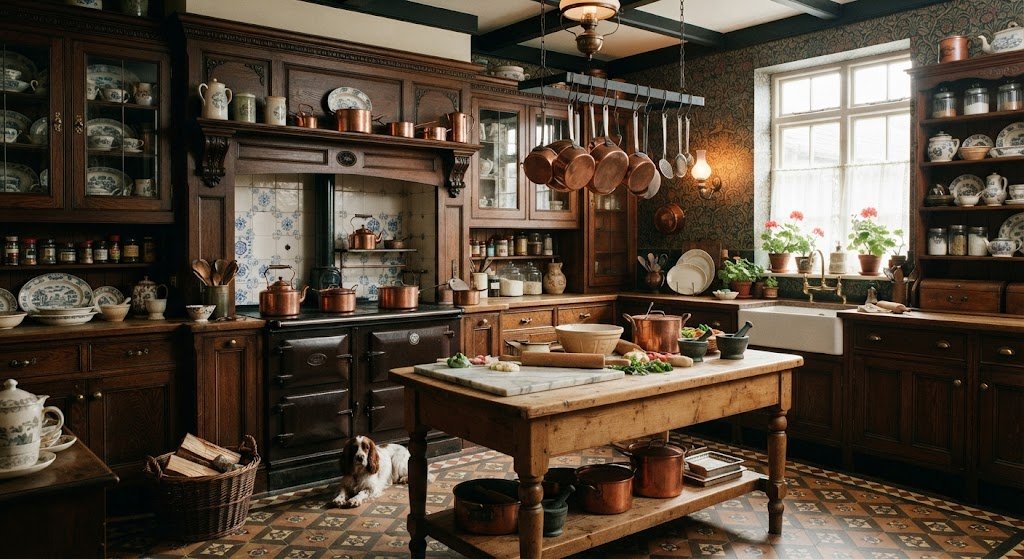
A victorian style kitchen combines the character of a period home with the practical features people expect from a modern kitchen. Think painted or timber cabinetry, detailed mouldings, traditional tiles, natural-looking worktops, classic lighting, and plenty of personality.
The style does not have to feel dark, old-fashioned, or overly formal. With the right balance, you can borrow the architectural charm of the Victorian era while still creating a bright, comfortable kitchen that works for everyday cooking, family meals, and entertaining.
From colour choices and cabinet styles to flooring, splashbacks, handles, and lighting, the small decisions make a surprisingly big difference. Here are practical ways to create the look without turning your kitchen into a museum.
What Defines a Victorian Style Kitchen?
Victorian kitchens are strongly associated with craftsmanship, practical materials, decorative details, and the architectural character of nineteenth-century homes. Modern interpretations usually take those visual cues and combine them with contemporary appliances, storage, lighting, and work surfaces.
A traditional Victorian-inspired kitchen often includes:
- Shaker-style or framed cabinets
- Painted timber cabinetry
- Classic ceramic or porcelain tiles
- Natural stone or stone-look worktops
- Freestanding furniture
- Traditional handles and knobs
- Butler-style or ceramic sinks
- Period-inspired lighting
- Decorative cornices and mouldings
- Muted or rich heritage-inspired colours
- Timber, stone, or patterned flooring
The key is balance. If every surface is heavily decorated, the room can feel busy. If everything is ultra-modern, the Victorian character may disappear.
A good design usually chooses a few strong period details and lets them do the talking.
Choose Cabinets With Traditional Character
Cabinetry is one of the easiest ways to establish the overall style.
Simple Shaker doors are particularly useful because their clean lines feel traditional without being excessively ornate. Framed cabinets can also create a more furniture-like appearance, especially when paired with visible hinges, detailed trim, or traditional handles.
Painted Cabinets
Painted cabinetry works well when you want a softer interpretation of the style.
Consider shades such as:
- Warm white
- Cream
- Soft grey
- Sage green
- Deep green
- Muted blue
- Charcoal
- Warm taupe
You do not need to use the same colour throughout the entire kitchen. A darker island beneath pale perimeter cabinets can add depth without making the room feel heavy.
Timber Cabinets
Natural timber can bring warmth and texture to a Victorian-inspired room. Oak, walnut, and other timber finishes can work particularly well when the surrounding colours and materials are kept relatively simple.
Avoid making every element compete for attention. If the cabinets have a strong wood grain, understated tiles and worktops may create a better overall balance.
Use Traditional Hardware to Add Detail
Handles may seem like a small decision, but they can completely change the personality of kitchen cabinets.
For a Victorian-inspired design, look at:
- Cup pulls
- Simple knobs
- Bin-style handles
- Aged brass finishes
- Antique-style metal finishes
- Dark metal hardware
- Ceramic knobs
The hardware should work with the rest of the room rather than trying to look artificially old.
For example, warm brass handles can complement cream cabinets, timber flooring, and warm lighting. Dark hardware can create more contrast against pale cabinetry.
Consistency matters, too. Using several unrelated metal finishes can make a traditional kitchen feel visually disjointed.
Pick a Colour Palette That Feels Period Appropriate
Colour can make the difference between a Victorian-inspired kitchen and a generic traditional kitchen.
Victorian homes are often associated with richer, more complex colour schemes, but you do not need to cover the room in dark shades.
A layered palette can work better.
Light Victorian Kitchen
For a brighter room, combine:
- Warm white cabinets
- Cream or off-white walls
- Natural timber
- Soft grey stone
- Brass hardware
- Patterned floor tiles
This approach keeps the kitchen light while adding traditional character.
Darker Victorian Kitchen
For a more dramatic appearance, consider:
- Deep green cabinets
- Navy or blue-grey cabinetry
- Dark timber
- Brass details
- Cream tiles
- Warm pendant lighting
Dark colours are especially effective when the room has plenty of natural light.
Two-Tone Cabinetry
Two-tone cabinets can also create an interesting period-inspired look. Try a lighter colour around the perimeter with a deeper shade on the island.
This gives the kitchen visual structure without requiring elaborate decoration.
Add a Classic Kitchen Sink
The sink is another opportunity to strengthen the traditional character.
A deep ceramic or fireclay-style sink can give a kitchen a strong period feel, particularly when paired with a traditional-looking tap.
Consider a sink that is:
- Deep enough for large cookware
- Proportional to the cabinet run
- Easy to clean
- Compatible with your chosen worktop
- Appropriate for the amount of daily use
A traditional appearance should not come at the expense of practicality. Think about how much washing you actually do by hand and how much space you need around the sink before choosing a model.
Select Worktops That Complement the Style
The worktop should connect the cabinetry, flooring, walls, and other materials.
Natural stone can create an authentic, substantial appearance, while engineered stone and other modern surfaces can provide a similar visual effect with different maintenance requirements.
Good choices may include:
- Marble
- Granite
- Quartz
- Soapstone
- Timber
- Stone-look surfaces
The right option depends on how you use the kitchen.
For example, a busy family kitchen may benefit from a worktop chosen primarily for durability and ease of maintenance. A kitchen designed around a historic property may place greater emphasis on natural materials and visual authenticity.
Do not choose a worktop in isolation. Always view a sample beside your cabinet colour, flooring, tiles, and hardware.
Make Tiles Part of the Design
Tiles are one of the most flexible elements in a Victorian-inspired kitchen.
Classic rectangular wall tiles can provide a clean period feel, while patterned floor tiles can make the room more decorative.
Popular approaches include:
- White ceramic wall tiles
- Handmade-look tiles
- Small-format tiles
- Geometric floor patterns
- Encaustic-style patterns
- Checkerboard floors
- Decorative borders
- Dark grout with pale tiles
Keep the Splashback Simple
If your floor already has a strong pattern, consider keeping the splashback relatively quiet.
Likewise, a simple floor can give you more freedom to use decorative wall tiles.
The goal is not to include every traditional feature available. It is to create a room where each feature supports the others.
Consider Patterned Flooring
Flooring can give a Victorian-style kitchen a strong sense of place.
Traditional-looking flooring options include timber, stone, ceramic tile, porcelain tile, and patterned tile designs.
A geometric pattern can be particularly effective because it adds visual interest without requiring elaborate furniture.
Before choosing flooring, consider:
- Moisture exposure
- Cleaning requirements
- Slip resistance
- Underfloor heating compatibility
- Traffic levels
- Installation requirements
- The existing floor structure
A beautiful floor that is difficult to maintain may become frustrating in a busy kitchen.
Use Lighting to Create Warmth
Lighting deserves more attention than it often receives.
A Victorian-inspired kitchen can look completely different under harsh, cool lighting compared with warm, layered illumination.
Use several types of lighting rather than relying on one central fixture.
Ambient Lighting
This provides general illumination throughout the room.
Task Lighting
Place focused lighting where you prepare food, wash dishes, and cook.
Decorative Lighting
Pendant lights, wall lights, and traditional-style fixtures can add character while contributing to the overall atmosphere.
For a period-inspired room, consider fixtures with:
- Brass details
- Opal or frosted glass
- Simple metal shades
- Traditional proportions
- Warm finishes
The fixture does not have to be an exact historical reproduction. It simply needs to feel compatible with the room.
Add a Freestanding Piece of Furniture
One of the easiest ways to make a kitchen feel less like a row of fitted cabinets is to introduce furniture-style pieces.
A freestanding dresser, island, Welsh dresser-inspired unit, or timber shelving can provide that effect.
This approach works particularly well in larger kitchens because it breaks up long runs of cabinetry.
It can also provide useful storage for:
- Crockery
- Glassware
- Cookbooks
- Serving pieces
- Everyday kitchen accessories
Choose furniture that provides both storage and visual character rather than adding pieces simply because they look traditional.
Create a Victorian-Inspired Kitchen Island
An island does not need to look like it came from the same cabinet catalogue as everything else.
A furniture-style island can give the kitchen a more collected appearance.
Try combining:
- Painted base cabinets
- A contrasting worktop
- Decorative legs or end panels
- Traditional handles
- Open shelving
- A different cabinet colour
For smaller kitchens, avoid making the island too large. You need enough room to move comfortably around it, open drawers, and use nearby appliances.
An oversized island can make a beautifully designed kitchen surprisingly difficult to live with.
Use Open Shelving Carefully
Open shelving can add warmth and make everyday items easy to reach.
Wooden shelves are particularly effective in a Victorian-inspired kitchen because they introduce natural texture.
Use them for items you genuinely use, such as:
- Plates
- Mugs
- Bowls
- Glass jars
- Cookbooks
- Small plants
Avoid filling every shelf with decorative objects. A little breathing room helps the kitchen look intentional rather than cluttered.
If you prefer a cleaner appearance, use a combination of closed cabinetry and one or two open shelves.
Bring in Period-Inspired Architectural Details
If you live in an older property, existing architectural features can become some of the strongest parts of the design.
Look for details such as:
- High ceilings
- Timber doors
- Original fireplaces
- Decorative skirting boards
- Cornices
- Exposed brick
- Timber beams
- Panelled walls
- Original floor features
Rather than covering these features, consider making them part of the kitchen scheme.
In a newer home, you can introduce selected details through cabinetry, mouldings, doors, handles, and lighting without trying to recreate an entire historic interior.
Add a Range Cooker or Traditional-Style Appliance
Large range-style cookers are often associated with traditional kitchens and can become a natural focal point.
However, the cooker should suit the room’s scale.
In a compact kitchen, a large appliance may overwhelm the space. In a generous kitchen, it can provide a strong visual anchor.
When selecting appliances, think beyond appearance. Consider ventilation, electrical or fuel requirements, cleaning, maintenance, and the way your household actually cooks.
Modern appliances can sit comfortably in a traditional room. You do not need every appliance to look vintage.
Mix Modern Convenience With Traditional Design
A successful Victorian-inspired kitchen does not need nineteenth-century technology.
Hidden or integrated modern features can make the room much more comfortable to use.
You can combine traditional cabinetry with:
- Modern ovens
- Induction cooking
- Integrated refrigeration
- Dishwashers
- Modern extraction
- Efficient lighting
- Soft-close drawers
- Pull-out storage
- Waste-sorting systems
- Charging points
This combination is often the sweet spot: old-world appearance with modern functionality.
The visual style can reference the past while the kitchen works exactly as a contemporary household needs it to.
Choose a Backsplash That Supports the Room
The backsplash should protect the wall while contributing to the design.
For a quieter appearance, use simple white or cream tiles. If the cabinets are plain, you have more freedom to introduce colour or pattern.
You could also use the backsplash to highlight a cooking area with:
- Decorative tilework
- A framed tile section
- A contrasting colour
- Natural stone
- A subtle geometric pattern
Do not feel obliged to cover every wall with decorative tile. Sometimes a carefully chosen section has more impact.
Add Personality With Accessories
Accessories are where the kitchen can start to feel lived in.
Consider:
- Wooden chopping boards
- Ceramic storage jars
- Linen textiles
- Traditional-style clocks
- Copper or brass cookware
- Simple artwork
- Green plants
- Woven baskets
- Vintage-inspired containers
The trick is to avoid turning the kitchen into a collection of themed objects.
A few carefully chosen pieces usually look more convincing than dozens of deliberately “old-fashioned” accessories.
Victorian Style Kitchen Ideas for Small Spaces
You do not need a huge room to create the look.
In a small kitchen, focus on a few high-impact elements.
Use Light Colours
Cream, warm white, pale grey, and soft green can help the room feel more open.
Choose Slimmer Details
Simple cabinet profiles and modest hardware can create traditional character without visually overwhelming the room.
Use Vertical Storage
Tall cabinets and shelving can make better use of limited wall space.
Add One Strong Period Feature
This could be a traditional sink, patterned floor, classic pendant, or furniture-style cabinet.
You do not need all of them.
Keep Countertops Clear
A small kitchen becomes crowded quickly. Store appliances and accessories where possible rather than allowing every surface to become a display area.
Victorian Style Kitchen Ideas for Large Rooms
Large kitchens give you more freedom to layer materials and architectural details.
You might include:
- A substantial island
- Full-height cabinetry
- A large range cooker
- Freestanding furniture
- Open shelving
- Decorative tilework
- A dining area
- A pantry
- Multiple lighting zones
But a large room still needs visual discipline.
Use repeated finishes to connect different areas. For example, the same cabinet colour can appear on the island and a tall dresser, while the same metal finish can be repeated on handles and lighting.
How to Make the Style Feel Authentic Without Looking Dated
This is one of the biggest challenges with period-inspired interiors.
The answer is to focus on proportion, materials, and detail, rather than filling the room with antiques.
For example, traditional cabinetry can sit beside a sleek induction hob. A classic ceramic sink can work with a modern dishwasher. Heritage-inspired colours can sit alongside contemporary lighting.
The kitchen feels connected to the past without sacrificing present-day comfort.
Avoid making every element heavily decorative. Victorian architecture had plenty of ornament, but a modern kitchen also needs clear work surfaces, efficient storage, and comfortable movement.
Common Mistakes to Avoid
1. Making Everything Dark
Deep colours can be beautiful, but using them on cabinets, walls, floors, and ceilings may make the room feel heavy.
Balance darker elements with lighter surfaces and good lighting.
2. Mixing Too Many Patterns
Patterned flooring, decorative backsplash tiles, ornate cabinet doors, patterned curtains, and busy accessories can compete with one another.
Choose a clear visual priority.
3. Ignoring Practical Storage
A beautiful kitchen still needs somewhere to put pans, food, appliances, cleaning supplies, and everyday dishes.
Plan storage before finalising decorative details.
4. Choosing Style Over Function
A sink, cooker, island, or cabinet should work for the people using the room.
A traditional appearance is not worth sacrificing comfort.
5. Using Artificially Aged Finishes Everywhere
Not every item needs to look antique. Excessive distressed finishes can make a kitchen feel themed rather than naturally traditional.
6. Forgetting the Existing Architecture
If the kitchen is part of a period property, look at the room itself before choosing finishes.
Existing doors, windows, floors, fireplaces, and mouldings can provide valuable design direction.
Victorian Kitchen Materials: A Simple Guide
| Element | Traditional-Inspired Choices | Practical Consideration |
|---|---|---|
| Cabinets | Painted timber, Shaker, framed doors | Choose finishes that suit daily use |
| Worktops | Stone, timber, marble, quartz | Consider maintenance and durability |
| Walls | Ceramic tile, painted walls | Protect areas exposed to cooking |
| Flooring | Timber, stone, patterned tile | Consider traffic and moisture |
| Sink | Deep ceramic or fireclay-style | Check size and cabinet compatibility |
| Hardware | Brass, dark metal, ceramic | Repeat finishes for cohesion |
| Lighting | Pendants, wall lights, classic fixtures | Layer ambient and task lighting |
| Shelving | Timber or painted shelves | Avoid excessive visual clutter |
How to Plan Your Victorian-Inspired Kitchen
Before ordering anything, create a simple design plan.
Step 1: Start With the Room
Measure the kitchen and identify doors, windows, radiators, plumbing points, electrical outlets, and structural features.
Step 2: Decide What Should Stand Out
Pick one or two focal points. It might be the range cooker, island, sink, floor, or cabinetry.
Step 3: Choose the Cabinet Style
Select the door profile and overall cabinet colour before choosing smaller details.
Step 4: Build a Material Palette
Collect samples of:
- Cabinet colour
- Worktop
- Tiles
- Flooring
- Hardware
- Paint
- Lighting finishes
View them together rather than separately.
Step 5: Plan Storage Around Real Habits
Think about where you prepare food, where you unload groceries, where pans are stored, and which appliances you use most.
Step 6: Add Period Details
Once the practical layout is working, introduce mouldings, hardware, lighting, furniture, and decorative touches.
This order helps prevent style decisions from creating functional problems.
Should You Choose a Fully Traditional or Modern Victorian Kitchen?
There is no need to choose one extreme.
| Approach | Appearance | Best For |
|---|---|---|
| Fully traditional | Strong period character | Historic homes and classic interiors |
| Modern Victorian | Traditional details with modern appliances | Most contemporary households |
| Soft Victorian | Light colours and restrained details | Smaller or brighter kitchens |
| Dramatic Victorian | Deep colours and rich materials | Large rooms with strong architectural features |
For most homeowners, a modern Victorian approach offers the easiest balance. You can preserve the visual character while getting the storage, appliances, lighting, and convenience expected from a modern kitchen.
FAQ
What colours work best in a Victorian style kitchen?
Warm whites, creams, muted greens, deep greens, soft blues, greys, taupes, and other layered heritage-inspired shades can work well. The best choice depends on natural light, room size, cabinetry, flooring, and the overall mood you want.
Are Shaker cabinets suitable for a Victorian kitchen?
Yes. Their simple framed appearance can work particularly well in Victorian-inspired designs. Pairing them with traditional hardware, suitable colours, classic lighting, and period-inspired materials can strengthen the look.
Can a Victorian kitchen have modern appliances?
Absolutely. Modern appliances can make a traditional kitchen much easier to use. The important thing is to balance contemporary functionality with cabinetry, materials, hardware, and architectural details that establish the desired character.
What flooring works with a Victorian-inspired kitchen?
Timber, natural stone, ceramic or porcelain tiles, and patterned tile designs can all work. The choice should consider the room’s traffic, moisture exposure, maintenance needs, and relationship with the other finishes.
How can I make a small kitchen look Victorian?
Focus on a few strong details rather than decorating every surface. A traditional sink, Shaker cabinetry, classic handles, patterned flooring, or a period-inspired light can create character without overwhelming a small room.
Does a Victorian kitchen have to look old-fashioned?
No. The strongest modern interpretations borrow traditional details while incorporating contemporary appliances, storage, lighting, and work surfaces. The result can feel classic without looking dated.
Conclusion
A victorian style kitchen works best when it captures the character of the period without copying every detail from the past. Traditional cabinetry, classic tiles, warm colours, furniture-style pieces, heritage-inspired lighting, and carefully chosen hardware can establish the look.
The most important decision is not how many Victorian features you can fit into the room. It is how well those features work together and how comfortably the kitchen supports everyday life.
Start with the layout, choose durable materials, identify one or two focal points, and then add traditional details gradually. That approach can give you a kitchen with genuine character while keeping it practical enough for modern cooking, storage, and family life.



















