

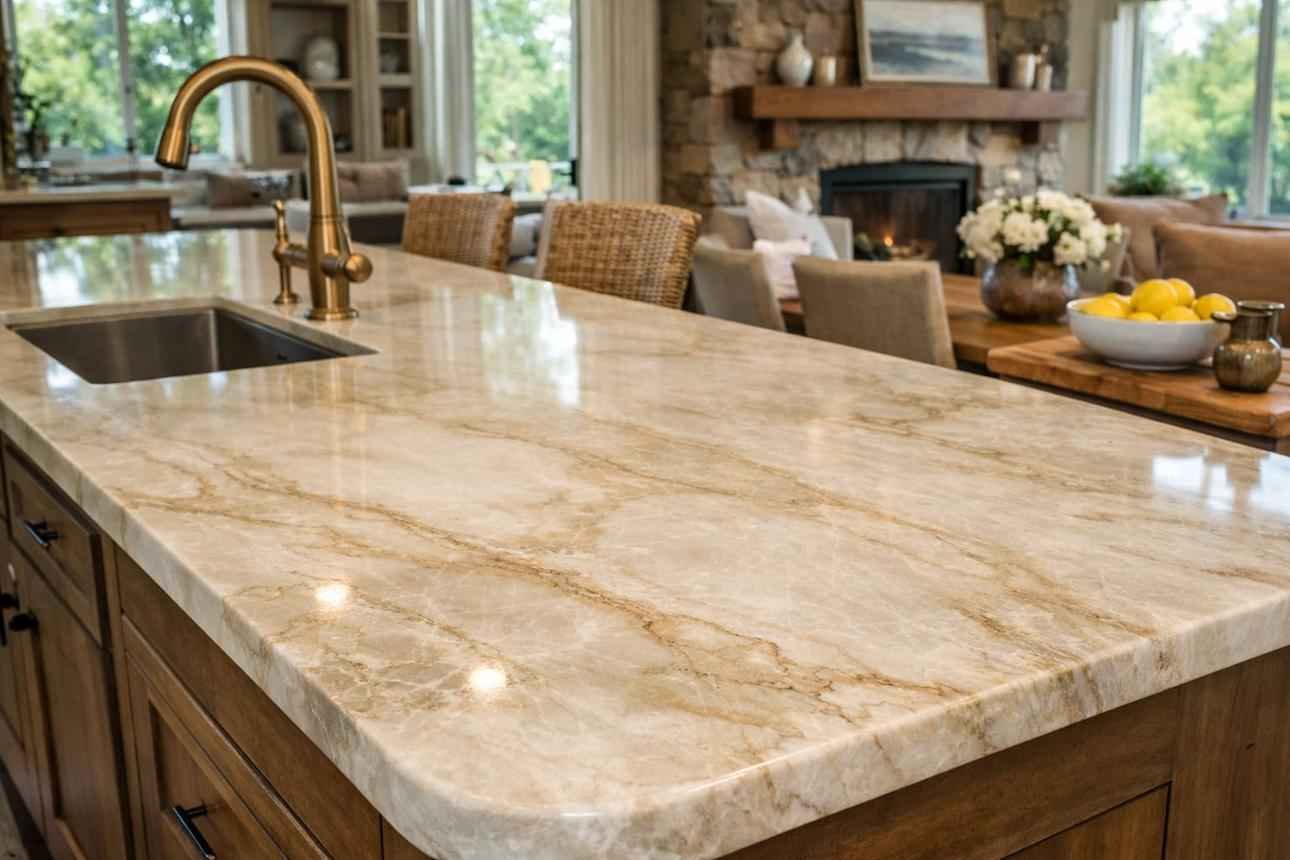
Taj Mahal quartzite has become a popular choice for homeowners who want the soft, elegant look of marble without giving up the practical benefits of a harder natural stone. Its creamy white to beige background, subtle gold and taupe movement, and natural variation give kitchens and bathrooms a warm, upscale appearance.
But appearance is only part of the decision. If you’re considering this stone for a countertop, island, backsplash, vanity, fireplace, or feature wall, you also need to understand how it performs, what finishes are available, how much maintenance it needs, and what to check before buying a slab.
What Is Taj Mahal Quartzite?
Taj Mahal quartzite is a natural quartzite from Brazil. It is generally recognized by its warm ivory, cream, or beige background and soft veins in shades of gold, beige, taupe, and sometimes gray. The stone is commonly sold as a marble-look natural stone because its pattern has the movement people often associate with high-end marble.
Unlike engineered quartz, it is quarried as a natural stone. Each slab can therefore have its own pattern, color variation, and veining.
The name can also create some confusion. Taj Mahal quartzite is not the same material as the Taj Mahal monument in India, and it is not engineered quartz. It is a commercial stone name used for a Brazilian natural stone.
Is Taj Mahal Quartzite Really Quartzite?
The material is commonly marketed and sold as quartzite, including by major stone suppliers such as Arizona Tile and MSI. However, natural stone names and commercial classifications can sometimes vary between suppliers and individual lots.
That’s why it is smart to inspect the actual slab you’re buying rather than relying only on a sample or product name.
For an expensive countertop project, ask the fabricator or supplier about the specific slab’s material classification, care requirements, and recommended use.
What Does It Look Like?
The appeal of this stone comes from its warm, understated appearance.
Typical Taj Mahal slabs feature:
- Creamy white or ivory backgrounds
- Warm beige undertones
- Soft gold or honey-colored veins
- Taupe or light gray movement
- Cloudy or layered patterns
- Natural crystalline variation
Some slabs are relatively calm, while others have stronger movement. That difference matters when you’re designing a large kitchen island because the slab you select can influence the entire room.


7
Why Is the Color So Popular?
Cool whites and gray surfaces can make a room feel crisp, but warm neutrals often create a softer atmosphere. Taj Mahal works especially well with:
- White cabinetry
- Cream cabinets
- Natural wood
- White oak
- Warm beige walls
- Brass hardware
- Matte black accents
- Soft neutral flooring
Its low-contrast appearance also makes it easier to combine with other materials without creating a visually busy room.
Taj Mahal Quartzite vs. Marble
The biggest reason homeowners consider Taj Mahal quartzite is often the combination of marble-like beauty and quartzite’s hardness.
| Feature | Taj Mahal Quartzite | Marble |
|---|---|---|
| Appearance | Warm, marble-like movement | Classic veining and variation |
| Natural stone | Yes | Yes |
| Scratch resistance | Generally high | Generally lower |
| Acid etching | Generally more resistant | More susceptible |
| Maintenance | Requires appropriate stone care | Requires more care around acids |
| Slab variation | High | High |
| Best use | Countertops, islands, vanities, walls | Countertops, vanities, walls and decorative uses |
Arizona Tile describes Taj Mahal as a Brazilian quartzite that resembles Calacatta-style marble while offering greater hardness and durability than marble.
That doesn’t mean the stone is indestructible. Natural stone can still chip, stain, crack, or react differently depending on the particular material, finish, fabrication, and installation.
Taj Mahal Quartzite vs. Quartz
The words quartzite and quartz sound similar, but they describe very different countertop materials.
Taj Mahal quartzite is natural stone quarried from the earth.
Engineered quartz is a manufactured surface made using quartz-containing material combined with resins and other components.
The practical differences include:
- Natural variation: quartzite has it; engineered quartz is manufactured for more consistency.
- Pattern: every natural slab is different.
- Fabrication: quartzite requires natural-stone fabrication.
- Maintenance: both can be relatively easy to live with, but care recommendations differ by product.
- Appearance: Taj Mahal provides genuine natural-stone variation that cannot be perfectly duplicated from slab to slab.
If you want the exact appearance of one particular Taj Mahal slab, you should select the actual slab rather than choosing solely from a small sample.
Is Taj Mahal Quartzite Durable?
Yes, quartzite is generally valued for its hardness and durability, which is one reason this material is commonly specified for kitchen countertops and other high-use surfaces.
MSI lists Taj Mahal for residential and commercial countertops, bathroom applications, walls, flooring, fireplaces, and other uses. Its product range includes polished, honed, and brushed finishes in both 2 cm and 3 cm thicknesses.
Still, durable does not mean maintenance-free.
A quartzite countertop can still be damaged by:
- Heavy impacts
- Poorly supported overhangs
- Improper fabrication
- Harsh chemicals
- Abrasive cleaning products
- Incorrect sealing practices
- Extreme localized stress
A good fabricator is just as important as the stone itself.
Does Taj Mahal Quartzite Need to Be Sealed?
Sealing requirements depend on the specific stone, finish, and supplier recommendations.
Don’t assume that every slab has exactly the same porosity simply because it carries the same commercial name.
Before installation, ask:
- Does this particular slab require sealing?
- Has it already been sealed?
- What sealer was used?
- When should it be resealed?
- What cleaner does the fabricator recommend?
- Is the finish polished, honed, leathered, or brushed?
The safest approach is to follow the fabricator’s care instructions for the exact stone you purchased.
How to Clean Taj Mahal Quartzite
For everyday cleaning, simple care is usually the best approach.
Daily Cleaning
Use:
- A soft microfiber cloth
- Warm water
- A stone-safe, pH-neutral cleaner when needed
Wipe spills rather than allowing them to sit on the surface for long periods.
Avoid experimenting with strong household chemicals just because the countertop appears tough.
What Should You Avoid?
Avoid abrasive powders, harsh scouring pads, and cleaners that are not intended for natural stone.
Acidic household products can also be problematic for some stone surfaces, particularly materials that contain minerals susceptible to acid reaction.
When in doubt, check the product manufacturer’s instructions or ask your stone fabricator.
What Finishes Are Available?
The finish changes how Taj Mahal looks and feels.
Polished
A polished finish has a smooth, reflective surface that emphasizes the stone’s color and movement.
It is a popular option for:
- Kitchen islands
- Countertops
- Bathroom vanities
- Fireplace surrounds
The reflective surface can make veining appear more pronounced.
Honed
Honed stone has a softer, more matte appearance.
It works well when you want:
- A relaxed appearance
- Less visual reflection
- A softer modern kitchen
- A more understated stone surface
Leathered or Brushed
Textured finishes can give the stone more tactile character and a less glossy appearance. Availability varies by supplier and slab.
MSI currently lists Taj Mahal in polished, honed, and brushed finishes, while other suppliers may offer additional textures depending on the material.
Where Can You Use Taj Mahal Quartzite?
This stone is versatile enough for many areas of the home.
Kitchen Countertops
The kitchen is one of its most common applications.
Taj Mahal can work beautifully on:
- Main countertops
- Kitchen islands
- Waterfall edges
- Backsplashes
- Full-height backsplash walls
A large island can showcase the natural movement of a full slab particularly well.
Bathroom Vanities
Its warm neutral color works naturally with white, cream, beige, and wood bathroom finishes.
It can be used for:
- Vanity tops
- Shower walls
- Wall panels
- Tub surrounds
Always confirm that the selected slab and finish are appropriate for the intended installation.
Fireplace Surrounds
The soft coloring makes Taj Mahal a good choice when you want a fireplace to feel elegant without dominating the room.
It pairs particularly well with:
- Natural wood mantels
- Cream walls
- White fireplaces
- Brass details
- Minimalist interiors
Feature Walls
Large slabs can create a dramatic continuous surface with fewer visual interruptions than small-format tile.
How Much Does Taj Mahal Quartzite Cost?
There is no single reliable price for Taj Mahal quartzite.
The final cost can vary based on:
- Slab grade
- Slab size
- Thickness
- Finish
- Veining
- Supplier
- Region
- Availability
- Fabrication
- Edge profile
- Cutouts
- Installation
- Number of slabs required
The stone itself is only one part of a countertop project’s total price.
For an accurate quote, get pricing based on your actual kitchen measurements and the specific slab you intend to purchase.
Be cautious about online articles that give one universal price as though every Taj Mahal slab costs the same. Natural stone pricing can change significantly between suppliers and individual lots.
What Should You Check Before Buying?
This is one of the most important parts of the buying process.
1. View the Full Slab
Small samples cannot show you the complete pattern.
A slab may have:
- Large veins
- Darker sections
- Cloudy areas
- Color shifts
- Crystalline patches
- Natural fissures
Seeing the entire slab gives you a much better idea of what your finished countertop will look like.
2. Match Slabs for Large Projects
If your kitchen requires two or more slabs, ask to see them together.
This is especially important for:
- Large islands
- Waterfall edges
- Full-height backsplashes
- Bookmatched installations
The goal isn’t necessarily to make every slab identical. Instead, you want to understand how the pieces will work together.
3. Ask About the Exact Stone
Don’t purchase solely based on the label “Taj Mahal.”
Ask the supplier to identify:
- Stone type
- Country of origin
- Slab lot
- Finish
- Thickness
- Recommended applications
- Care instructions
4. Look for Natural Features
Natural stone isn’t supposed to look like a perfectly printed surface.
Inspect the slab for:
- Fissures
- Veins
- Mineral concentrations
- Filled areas
- Surface imperfections
- Edge conditions
Your fabricator can explain which characteristics are normal and which may affect fabrication or performance.
Design Ideas for Taj Mahal Quartzite
Taj Mahal works with more design styles than its luxury appearance might suggest.
Warm White Kitchen
Pair it with white cabinets, warm wood flooring, and brass hardware for a classic kitchen that doesn’t feel cold.
Wood and Quartzite
Natural oak or walnut cabinetry can bring out the beige and golden movement in the stone.
Cream-on-Cream Design
For a softer interior, combine Taj Mahal with cream cabinetry, warm walls, and light wood.
Modern Contrast
You can also use it with darker cabinetry, black fixtures, or charcoal accents. The contrast allows the warm stone to become the visual bridge between light and dark elements.
Waterfall Island
A waterfall edge can make the veining more noticeable because the stone continues vertically over the sides of the island.
For a large waterfall island, plan the slab layout with your fabricator before cutting begins.


4
Common Mistakes to Avoid
Choosing From a Tiny Sample
A small sample cannot represent every part of a natural slab.
Ignoring Slab Placement
The most beautiful vein may end up behind an appliance if the layout isn’t planned carefully.
Assuming Every Slab Is Identical
Natural stone varies. Even slabs sold under the same name can have different movement and color.
Treating Quartzite Like Engineered Quartz
Natural stone has different care requirements. Follow the recommendations for your particular slab.
Focusing Only on the Stone Price
Fabrication, installation, edge work, sink cutouts, backsplash pieces, and slab quantity can all affect the final project cost.
Skipping the Fabricator Conversation
A qualified fabricator can help determine whether your selected slab is appropriate for the design, how it should be cut, and where seams should be placed.
Is Taj Mahal Quartzite Worth It?
For homeowners who love the appearance of warm marble but want a harder natural-stone surface, Taj Mahal can be an excellent option to consider.
Its biggest advantages are its combination of:
- Warm neutral coloring
- Natural variation
- Marble-like movement
- Quartzite classification
- Broad design flexibility
- Availability in several finishes
- Suitability for many residential applications
The main drawback is that natural stone selection requires more attention than simply picking a uniform manufactured surface. You need to evaluate the actual slab, understand its care requirements, and plan the fabrication carefully.
If you’re remodeling a kitchen or bathroom, the best question isn’t simply, “Is Taj Mahal quartzite good?”
A better question is: “Does this particular slab work for my design, budget, fabrication plan, and maintenance expectations?”
That approach will lead to a much better purchase.
Frequently Asked Questions
Is Taj Mahal quartzite expensive?
It can be a premium natural-stone option, but there is no universal price. Cost depends on the slab, grade, thickness, finish, supplier, region, fabrication, and installation.
Is Taj Mahal quartzite better than marble?
It depends on what you value. Taj Mahal quartzite is generally chosen when homeowners want a marble-like appearance with greater hardness and resistance to everyday scratching and acid-related etching than typical marble.
Can Taj Mahal quartzite be used for kitchen countertops?
Yes. Major stone suppliers list Taj Mahal quartzite for residential kitchen countertops and islands.
Does Taj Mahal quartzite stain?
Natural stone can stain under the right conditions, so spills should be cleaned promptly and the stone should be cared for according to the supplier’s recommendations. Sealing requirements vary by the particular material.
What colors go with Taj Mahal quartzite?
White, cream, beige, natural wood, warm gray, brass, black, and earthy colors can all work well. The best combination depends on the undertones and movement of your individual slab.
Is Taj Mahal quartzite the same as engineered quartz?
No. Taj Mahal is sold as a natural quartzite, while engineered quartz is a manufactured surface. Always confirm the material specification with your supplier before purchasing.
Conclusion
Taj Mahal quartzite stands out because it combines a warm, sophisticated appearance with the practical qualities homeowners often want from a durable natural stone. Its creamy background and gentle gold, beige, and taupe movement can complement everything from traditional white kitchens to modern wood-and-brass interiors.
The smartest way to buy it is to focus on the actual slab, not just the name. Compare full slabs, discuss the layout with your fabricator, confirm the stone’s care requirements, and calculate the complete installed cost before committing.
For the right project, Taj Mahal can provide the marble-inspired look many homeowners love while bringing a distinctly natural character that a manufactured surface cannot exactly reproduce.



















