

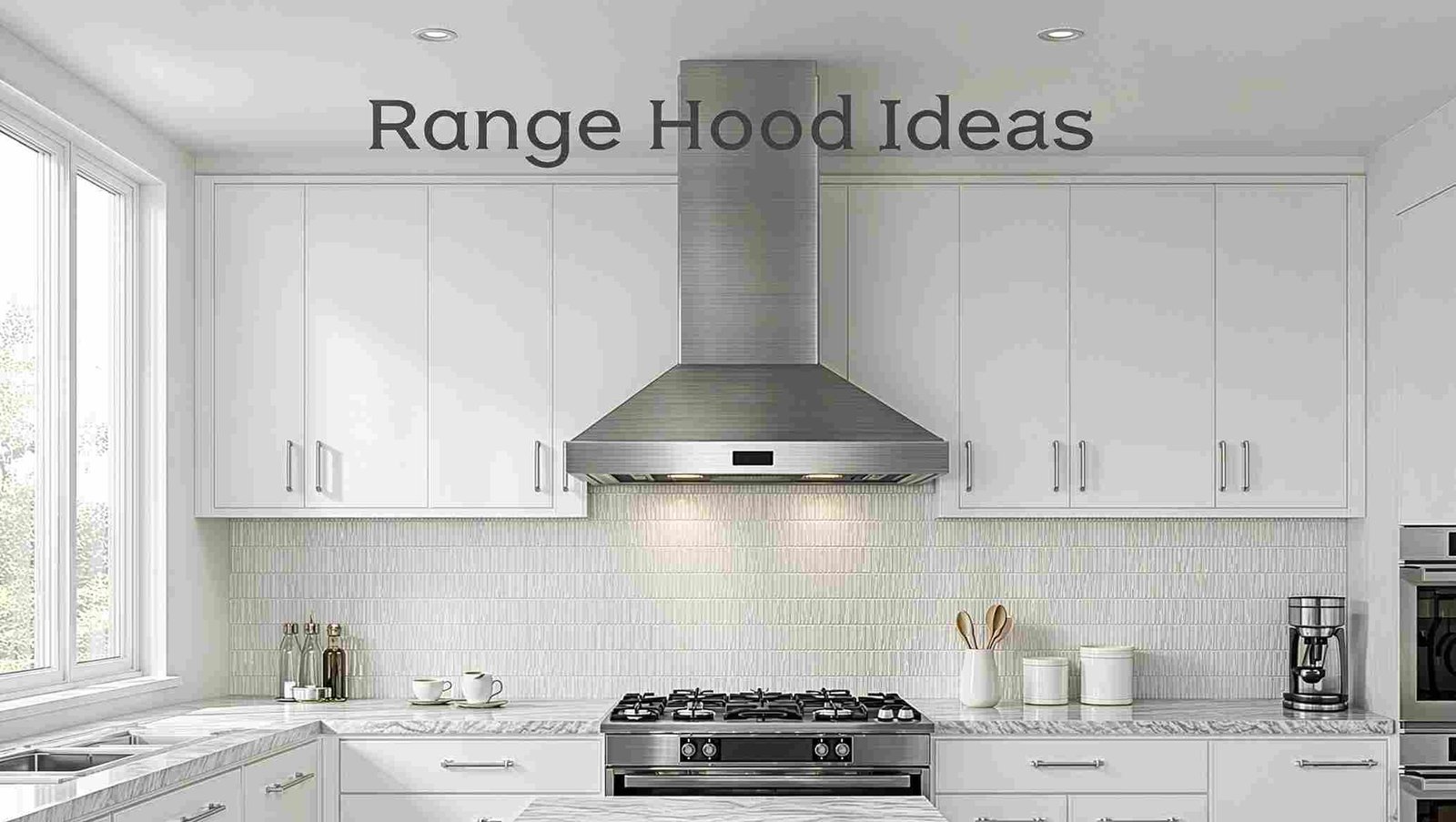
A range hood can be much more than a practical appliance above your cooktop. With the right design, it can become one of the strongest visual features in your kitchen, adding shape, texture, and personality while helping remove cooking odors, smoke, grease, and excess moisture.
The best range hood ideas balance style, size, ventilation, and the layout of the kitchen. A dramatic plaster hood may look beautiful in a large kitchen, while a slim stainless-steel hood may make more sense in a compact apartment. The key is choosing a hood that works with the way you cook rather than treating it as an afterthought.
From sleek contemporary designs to wood-clad farmhouse hoods and custom statement pieces, there are plenty of ways to make your range hood fit the room. Below are practical ideas to help you choose a look that works visually and functionally.
15 Range Hood Ideas for Different Kitchen Styles
1. Make a Range Hood the Kitchen Focal Point
If your kitchen feels visually flat, a large statement hood can give the cooking area a clear center.
Instead of hiding the hood, frame it with a distinctive material or shape. A curved hood, oversized chimney, plaster finish, or contrasting surround can immediately draw attention to the range wall.
This approach works particularly well when the rest of the kitchen is relatively simple. Neutral cabinets and a restrained backsplash allow the hood to become the architectural feature.
Try this look with:
- White or cream cabinets
- A simple backsplash
- A wide sculptural hood
- Brass or black hardware
- Open shelving on either side
The goal is not necessarily to make the hood the biggest object in the room. It is to make it feel intentional.
2. Try a Modern Stainless-Steel Hood
Stainless steel remains a practical choice for contemporary kitchens because it has a clean appearance and works with many appliances.
A stainless-steel wall hood can look especially good with flat-panel cabinets, stone countertops, large-format backsplash tile, or minimalist hardware.
For a more integrated appearance, choose a hood with simple lines and avoid unnecessary decorative details.
Best for: modern, industrial, transitional, and professional-style kitchens.
3. Use a Wood Range Hood for Warmth
Wood can soften a kitchen filled with hard surfaces such as stone, tile, glass, and metal.
A wood hood can match the cabinetry for a built-in appearance, or it can deliberately contrast with the cabinets. For example, light oak cabinetry paired with a slightly darker wood hood creates visual separation without introducing a completely different color.
You can also use painted wood for a more traditional or farmhouse appearance.
Design tip: If you are using several wood tones, keep the undertones compatible. Mixing a warm honey oak with a very cool gray-brown wood can make the room feel less cohesive.
4. Choose a Plaster or Drywall Hood
A smooth plaster-style hood can give a kitchen a custom architectural appearance without relying on stainless steel as the visible finish.
This style works particularly well with:
- Mediterranean-inspired kitchens
- European-style interiors
- Warm minimalist kitchens
- Transitional spaces
- Traditional kitchens
A plaster hood can be painted to blend with the walls or given a contrasting finish.
The advantage is visual simplicity. Instead of looking like an appliance, the hood can look like part of the architecture.
5. Add a Curved Range Hood
Straight lines dominate many modern kitchens, so a curved hood can introduce a softer shape.
A gently arched hood works well above a large range, especially when the kitchen already contains curved elements such as:
- Arched doorways
- Curved islands
- Round pendant lights
- Arched shelving
- Rounded furniture
You do not need several curved elements for the idea to work. Even one carefully chosen curve can soften a boxy kitchen.
6. Go for a Farmhouse-Style Hood
Farmhouse kitchens often benefit from a substantial hood with a simple, handcrafted appearance.
A painted wood hood with a slightly wider profile can complement shaker cabinets, apron-front sinks, natural wood accents, and classic tile.
Popular finishes include:
- Warm white
- Cream
- Soft gray
- Natural wood
- Muted green
- Deep charcoal
Avoid making every element equally rustic. Pairing a traditional hood with modern lighting or simple hardware can create a more current transitional look.
7. Install a Black Range Hood for Contrast
Black is an easy way to create contrast without introducing a bright accent color.
A black hood can work particularly well when the kitchen already includes black window frames, cabinet hardware, lighting, or appliances.
For example, white cabinets + a black hood + natural wood accents can create a balanced palette with plenty of visual contrast.
If the kitchen is small, however, a very large dark hood can become visually heavy. In that situation, a slimmer profile may work better.
8. Blend the Hood With the Cabinetry
Not every kitchen needs a statement hood.
If you prefer a calm, streamlined appearance, consider an integrated or cabinet-matched hood. The visible portion can be minimized so the cabinetry remains the dominant feature.
This is especially useful in smaller kitchens where a prominent hood could interrupt the visual flow.
A concealed design can also work beautifully in minimalist kitchens where clean cabinet lines are more important than decorative details.
9. Add a Metal Hood for an Industrial Look
Copper, brass, bronze, or other metal finishes can give a range hood an individual character.
Aged or warmer metals work well with:
- Dark cabinetry
- Natural stone
- Wood
- Handmade tile
- Warm lighting
A polished metal hood creates a different effect, with a more contemporary and reflective appearance.
Because a metal hood can become a strong focal point, keep nearby finishes relatively controlled.
10. Use a Two-Tone Hood
A two-tone hood gives you a way to connect different materials in the kitchen.
For example, you could combine:
- Painted wood + brass
- White plaster + wood trim
- Black metal + oak
- Stainless steel + cabinetry
- Cream + natural wood
This can be particularly useful when the kitchen already has two major finishes that need a visual bridge.
The hood becomes the element that ties them together rather than competing with them.
11. Frame the Hood With Open Shelving
Open shelves can make a large hood feel more integrated into the wall.
Install shelving on either side to create symmetry and provide a place for frequently used cookware, dishes, or decorative objects.
However, avoid placing items too close to the cooking surface where heat, steam, and grease could become a problem.
A practical arrangement is to keep the area immediately surrounding the range relatively uncluttered while using the shelves farther away for display.
12. Create a Built-In Range Wall
Instead of treating the hood as a standalone feature, design the entire range wall around it.
A built-in composition might include:
- The range
- A central hood
- Upper cabinets
- Open shelves
- Backsplash tile
- Side storage
- Countertop work areas
This approach makes the hood feel like part of a complete architectural composition.
It is particularly effective in larger kitchens where the range wall has enough width to create visual balance.
13. Use a Minimalist Floating Hood
For contemporary kitchens, a slim wall-mounted hood can preserve a sense of openness.
Look for simple forms without excessive decoration. Pair the hood with flat-panel cabinets, a restrained backsplash, and integrated appliances for a clean appearance.
This is one of the better approaches when you want ventilation without making the cooking area look visually busy.
14. Match the Hood to the Island
If your range or cooktop is located on an island, the hood becomes visible from almost every direction.
That makes its shape particularly important.
An island hood can be:
- Sculptural and dramatic
- Slim and contemporary
- Stainless steel and professional-looking
- Custom-clad in wood
- Finished in a color that contrasts with the island
Before choosing a large decorative hood, consider the sightlines from the living room, dining area, and main kitchen walkway. An island hood should look good from more than just the cooking position.
15. Make the Backsplash and Hood Work Together
The backsplash and range hood should be considered as a pair.
A bold backsplash behind a simple hood can look sophisticated. Likewise, a dramatic hood may need a quieter backsplash so the two features do not compete.
For example:
| Hood style | Backsplash approach |
|---|---|
| Stainless steel | Subway tile, slab stone, or simple tile |
| Wood | Marble, ceramic tile, or understated stone |
| Plaster | Handmade tile or natural stone |
| Black metal | Light tile or warm stone |
| Brass/copper | Neutral stone or simple tile |
| Cabinet-matched | Statement tile or slab backsplash |
The right combination depends on the overall color and texture balance of the room.
How to Choose the Right Range Hood Style
Before falling in love with a particular hood, consider how it will actually function in your kitchen.
Start With the Cooktop or Range
The hood should be selected around the cooking appliance, not the other way around.
Measure the cooking surface and check the hood manufacturer’s recommendations for appropriate hood width and installation height.
A hood that looks beautiful but is poorly matched to the cooking appliance may not capture cooking byproducts effectively.
Consider How You Cook
Someone who mostly boils water and prepares simple meals may have different ventilation needs from someone who frequently sears steaks, fries food, or cooks with high heat.
Think about:
- How often you cook
- Whether you frequently fry or sear
- Whether you use high heat
- Whether you cook with gas or electricity
- How open the kitchen is to other rooms
Your cooking habits should influence the ventilation system you choose.
Ducted vs. Recirculating Range Hoods
One of the most important decisions is how the hood handles the air it captures.
Ducted Hoods
A ducted hood sends cooking air outside through ductwork.
When properly designed and installed, this can be an effective way to remove cooking odors, moisture, smoke, and airborne grease from the kitchen.
However, the duct route matters. Long or complicated duct runs can affect system performance, and the installation needs to be appropriate for the building.
Recirculating Hoods
A recirculating hood filters the air and returns it to the kitchen rather than exhausting it outdoors.
This can be useful when exterior ducting is impractical, such as in some apartments or remodeling situations.
The trade-off is that it does not provide the same type of outdoor exhaust. Filters also need regular cleaning or replacement according to the manufacturer’s instructions.
Simple rule: If you can install a properly designed exterior exhaust system, it is worth considering. If ducting is not practical, a well-maintained recirculating system can be an alternative.
How Wide Should a Range Hood Be?
The correct hood width depends on the cooking appliance, hood design, installation instructions, and local requirements.
As a starting point, many kitchen designers choose a hood that is at least as wide as the cooking surface. Some installations use a wider hood to improve visual proportion and capture around the cooking area.
For example, a wider statement hood can make a large range feel more substantial, while a compact hood may be better suited to a small apartment kitchen.
Always check the manufacturer’s installation instructions rather than relying on a one-size-fits-all rule.
Range Hood Ideas for Small Kitchens
A small kitchen does not mean you have to sacrifice style.
The trick is to choose a hood that performs its job without overwhelming the room.
Consider:
- Slim wall-mounted designs
- Under-cabinet hoods
- Integrated cabinet hoods
- Simple stainless-steel finishes
- Light-colored hood surrounds
- Minimal decorative detailing
A concealed hood can be especially useful when cabinet storage is limited and you want the upper wall to feel continuous.
If the hood is visible, choosing a simple silhouette can keep the kitchen from feeling crowded.
Range Hood Ideas for Large Kitchens
Large kitchens provide more freedom to use the hood as architecture.
You can consider:
- Oversized custom surrounds
- Wide plaster hoods
- Wood-clad hoods
- Curved designs
- Decorative trim
- Statement metal finishes
- Large range-wall compositions
The important thing is proportion. A tiny hood above a large professional-style range can look lost, while an enormous hood in a modest kitchen may dominate the entire room.
Think about the hood, range, cabinets, backsplash, and island as one composition.
Should Your Range Hood Match Your Cabinets?
It can, but it does not have to.
A matching hood creates a quiet, built-in appearance. A contrasting hood creates a focal point.
Match the hood when you want:
- A calm visual style
- Minimalism
- Continuous cabinetry
- A traditional built-in appearance
Contrast the hood when you want:
- More visual interest
- A statement feature
- Stronger architectural definition
- A clear focal point above the range
There is no universal right answer. The choice depends on whether you want the hood to disappear or stand out.
Materials That Work Well for Custom Range Hoods
The visible hood surround can be finished in many materials, but the material should be appropriate for the installation and compatible with heat and moisture conditions.
Wood
Warm, versatile, and suitable for traditional, farmhouse, transitional, and contemporary kitchens.
Plaster-Style Finishes
Useful for creating an architectural appearance and blending the hood with surrounding walls.
Stainless Steel
Durable-looking, easy to coordinate with appliances, and particularly suitable for contemporary or professional-style kitchens.
Stone
A stone or stone-look surround can create a substantial luxury appearance, although the structural and installation requirements need careful consideration.
Metal
Copper, brass, bronze, and other metals can turn the hood into a decorative feature.
When choosing a material, think beyond color. Texture, reflectivity, maintenance, and how the finish will age all affect the final result.
Common Range Hood Design Mistakes to Avoid
Choosing Style Before Function
A beautiful hood is not useful if it does not suit the cooking appliance or ventilation setup.
Choose the ventilation system first, then work on the visible design.
Ignoring Ductwork
The visible hood is only one part of the system. Duct size, route, length, bends, and termination can affect performance.
If you are remodeling, discuss the ventilation route before finalizing cabinets and ceilings.
Making the Hood Too Small Visually
Even if a hood technically fits, it can look undersized against a large range wall.
Use the range, hood, cabinets, and backsplash together when judging proportion.
Overloading the Hood Wall
A statement hood does not need a dozen decorative elements around it.
If the hood is dramatic, give it breathing room.
Forgetting Maintenance
Grease and cooking residue can affect surfaces around the cooking area. Choose finishes that suit how much cleaning you are willing to do.
A gorgeous textured surface may require more care than a smooth, wipeable finish.
How to Make a Range Hood Look Expensive
You do not necessarily need an elaborate hood to create a polished kitchen.
Focus on proportion and detailing.
A simple hood can look sophisticated when:
- Its width is appropriate for the range.
- The surrounding cabinetry is well aligned.
- The backsplash is installed cleanly.
- Materials complement each other.
- Decorative details are restrained.
- The hood has enough visual space around it.
Good design often comes from making several elements work together rather than adding more decoration.
What Style of Range Hood Works With Different Kitchens?
| Kitchen style | Hood ideas |
|---|---|
| Modern | Slim metal, black, integrated, minimalist |
| Contemporary | Stainless steel, sculptural, two-tone |
| Farmhouse | Painted wood, simple custom hood |
| Traditional | Cabinet-matched, wood, decorative trim |
| Transitional | Plaster, painted wood, mixed materials |
| Industrial | Stainless steel, black metal, exposed details |
| Minimalist | Integrated, concealed, slim-profile |
| Mediterranean | Curved, plaster, warm textured finishes |
| Scandinavian | Light wood, simple white, understated forms |
Use this as a starting point rather than a strict design rule. A well-designed kitchen can successfully mix elements from several styles.
Range Hood Lighting Ideas
Lighting can make the cooking area more functional and visually attractive.
Many hoods include built-in lighting, but the hood is not always the only source you should consider.
A good kitchen lighting plan may combine:
- Hood task lighting
- Under-cabinet lighting
- Ceiling lighting
- Pendant lights over an island
- Accent lighting
The cooking surface should be comfortably illuminated without creating unnecessary glare.
If you are installing a custom hood, make sure lighting, electrical connections, access panels, and ventilation components are planned before construction is finished.
Safety and Installation Considerations
Range hood installation is not just a design decision.
Follow the manufacturer’s requirements for mounting height, electrical connections, ducting, filters, and clearances. Requirements can vary depending on the hood, cooking appliance, fuel type, and local building rules.
Gas cooking deserves particular attention because ventilation and combustion-related requirements can be different from those for electric or induction cooking.
If your installation involves new ductwork, electrical work, structural changes, or a gas appliance, use appropriately qualified professionals and check the requirements that apply to your location.
A Simple Way to Plan Your Range Hood
If you are starting a kitchen remodel, use this order:
Step 1: Identify the cooking appliance
Determine the range or cooktop size, fuel type, and manufacturer’s requirements.
Step 2: Decide on ventilation
Determine whether an exterior ducted system is practical or whether recirculation is necessary.
Step 3: Plan the duct route
Do this before cabinets, ceilings, or decorative surrounds are finalized.
Step 4: Choose the hood size
Use the appliance and manufacturer’s recommendations to determine an appropriate hood size.
Step 5: Select the visible style
Now choose wood, metal, plaster-style, integrated, or another finish.
Step 6: Coordinate the surrounding wall
Plan the backsplash, cabinetry, shelving, lighting, and countertops around the hood.
Step 7: Check the final proportions
Stand back and look at the entire cooking wall. The hood should feel like part of the room rather than a separate object attached at the last minute.
Frequently Asked Questions
What is the most popular range hood style?
There is no single style that works for every kitchen. Integrated and minimalist hoods suit contemporary spaces, while custom wood and plaster-style hoods are popular choices for traditional, transitional, and farmhouse-inspired kitchens.
Should a range hood be wider than the range?
A hood should be appropriately sized for the cooking appliance and the manufacturer’s recommendations. In many designs, a hood at least as wide as the cooking surface provides a sensible starting point, while a wider hood can also improve visual proportion.
Is a ducted range hood better than a recirculating one?
A ducted hood can remove cooking air from the building rather than filtering and returning it indoors, but installation conditions matter. A recirculating hood may be more practical where exterior ducting is not feasible.
Can a range hood be a design feature?
Absolutely. A hood can become a major architectural feature through its shape, size, material, color, or detailing. Custom wood, plaster-style, metal, and two-tone designs can all create a strong focal point.
What range hood works best in a small kitchen?
Slim, integrated, or under-cabinet designs are often easier to incorporate into a compact kitchen. A simple hood profile can provide ventilation without making the room feel crowded.
How do I make my range hood blend into the kitchen?
Match the hood surround to the cabinetry or wall finish, keep its shape simple, and coordinate it with the backsplash. Integrated designs are especially effective when you want the hood to visually disappear.
Conclusion
The right range hood should do two jobs well: support effective kitchen ventilation and complement the design of the room. That could mean a sleek stainless-steel hood in a modern kitchen, a warm wood surround in a farmhouse space, or a sculptural plaster-style hood that becomes the centerpiece of a larger cooking wall.
Start with the range or cooktop, ventilation requirements, ducting, and available space. Then choose the shape and finish that fit your kitchen’s style. When function and design are planned together, the hood can become one of the most useful—and attractive—features in the room.



















