

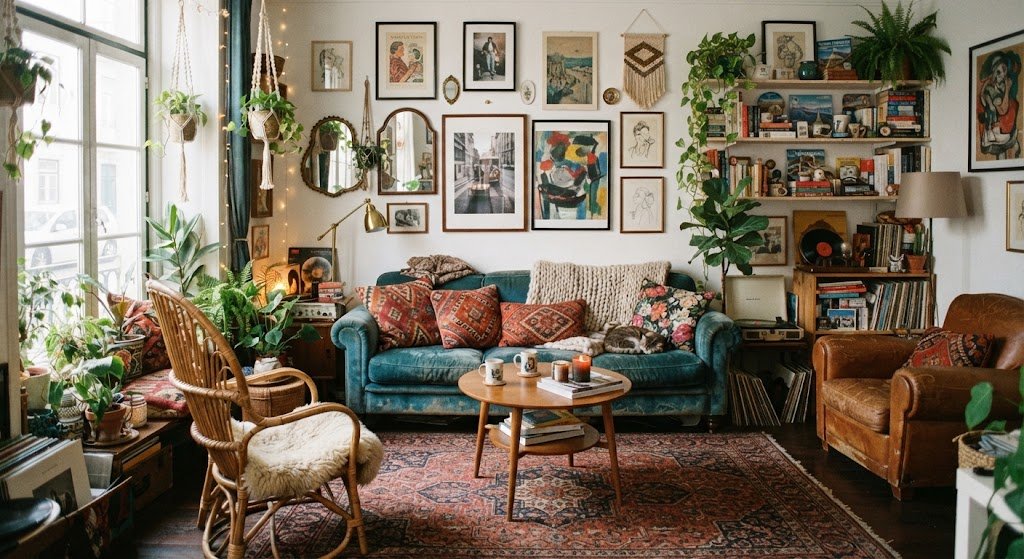
Eclectic interior design is about bringing different styles, colors, textures, periods, and influences together in one home. The goal is not to make everything match. It is to create a room where contrasting pieces still feel connected.
That balance is what makes an eclectic room work. A vintage wooden cabinet can sit beside a modern sofa, while patterned cushions, artwork, plants, and an unusual light fixture add personality. The individual pieces may come from different design traditions, but the room needs enough common ground to feel intentional rather than random.
The good news is that you do not need to replace everything in your home to achieve the look. A thoughtful color palette, repeated materials, consistent proportions, and a few meaningful statement pieces can turn a mixed collection of furniture and accessories into a cohesive space.
What Is Eclectic Interior Design?
Eclectic interior design is a decorating approach that combines elements from different styles, periods, colors, materials, and cultures rather than following one strict design style.
An eclectic room might combine:
- Mid-century furniture with traditional artwork
- Contemporary lighting with antique furniture
- Bold wallpaper with simple modern furnishings
- Natural wood with metal and glass
- Vintage accessories with newer decorative pieces
- Several patterns tied together by a shared color
- Different furniture shapes balanced through scale and proportion
The key distinction is intentional mixing.
Simply placing unrelated items in the same room does not automatically create a successful eclectic interior. The strongest spaces usually have a visual relationship between their contrasting elements. A repeated color, material, shape, finish, or pattern can provide that connection.
Think of the room as a conversation between different design influences. The pieces do not have to agree on everything, but they should have something to say to one another.
The Difference Between Eclectic and Maximalist Design
Eclectic and maximalist interiors can look similar, but they are not the same thing.
Eclectic design focuses on mixing different styles and influences. Maximalism generally focuses on abundance, layering, decoration, and visual richness.
An eclectic room can be relatively restrained. You might have a simple sofa, one vintage chair, a colorful rug, a few pieces of artwork, and a sculptural lamp. The variety comes from the differences between the pieces.
A maximalist room may contain many layers of color, patterns, objects, artwork, books, textiles, and decorative details.
They can overlap, but you do not need a heavily decorated room to create an eclectic look.
What Makes an Eclectic Room Feel Cohesive?
The biggest challenge is avoiding visual chaos. Several simple design principles can help.
Start With a Controlling Color Palette
Color is one of the easiest ways to connect pieces from different styles.
You do not necessarily need a neutral room. Instead, choose a few colors that appear repeatedly.
For example:
- Warm white for walls and larger surfaces
- Terracotta in cushions and artwork
- Deep green in upholstery and plants
- Natural wood throughout the room
- Brass or aged metal for selected accents
The same color does not have to appear in every object. Even small repetitions can create visual continuity.
A useful approach is to choose one dominant color, one or two supporting colors, and a few accent shades. This gives you freedom to experiment without allowing every new purchase to introduce a completely different visual language.
Repeat Materials
Materials can also connect otherwise unrelated furniture.
Suppose your room contains a contemporary sofa and an old wooden dresser. Repeating the dresser’s wood tone elsewhere can help it feel intentional. A wooden frame, side table, picture frame, or decorative bowl may be enough.
Other materials that can provide repetition include:
- Wood
- Linen
- Leather
- Ceramic
- Glass
- Rattan
- Stone
- Metal
You do not need to use the same finish everywhere. In fact, slight variations often make the room more interesting.
Pay Attention to Scale
Scale is often overlooked when people focus on color and decoration.
A large artwork beside tiny accessories can feel unbalanced. Likewise, several oversized pieces packed into a small room may make the space feel cramped.
Before adding another item, look at the relationship between:
- Furniture height
- Furniture width
- Artwork size
- Rug proportions
- Ceiling height
- Open floor space
- Decorative objects
Eclectic rooms benefit from variety, but that variety still needs visual breathing room.
Choose a Starting Point
Trying to design the entire room at once can make eclectic decorating unnecessarily difficult.
Start with one piece that you genuinely like.
It could be:
- A vintage rug
- A colorful sofa
- An antique cabinet
- A large painting
- A patterned armchair
- A sculptural light
- A collection of travel objects
- A distinctive coffee table
Then build around it.
If your starting point is a colorful rug, pull one or two colors from it for cushions or artwork. If it is a wooden antique, repeat its material or warm tone elsewhere.
This creates a natural foundation for the rest of the room.
Mix Old and New Furniture
One of the easiest ways to create an eclectic interior is to combine furniture from different periods.
A completely matching furniture set can make a room feel predictable. Mixing pieces gives it more character.
For example, a living room might contain:
- A clean-lined modern sofa
- A vintage wooden sideboard
- A traditional-style armchair
- A contemporary coffee table
- An antique-looking mirror
- Modern floor lighting
The important thing is not the exact age or label of each item. Look at how the pieces relate through color, proportion, material, and placement.
Don’t Make Every Piece a Statement
If every object is unusual, nothing stands out.
Choose a few pieces to carry the visual personality of the room and allow simpler items to support them.
For instance, if you have an ornate vintage cabinet, you might pair it with a relatively simple sofa and understated side tables. This gives the distinctive cabinet enough space to be appreciated.
Use Patterns Without Losing Control
Patterns are particularly effective in eclectic interiors, but they can quickly become overwhelming.
Instead of selecting patterns independently, look for a connection.
You could combine:
- A geometric rug
- Floral cushions
- Striped curtains
- Abstract artwork
They can still work together if they share colors or have a similar visual weight.
Vary the Scale of Patterns
Using three patterns of exactly the same visual intensity can make a room feel busy.
Try combining different scales instead.
For example:
- Large-scale floral wallpaper
- Medium geometric rug
- Small patterned cushions
This creates hierarchy. The eye can identify a primary pattern instead of treating every surface as equally important.
Layer Textures for Depth
Texture gives eclectic interiors warmth and prevents a room from relying entirely on color.
Consider combining smooth, rough, soft, natural, and reflective surfaces.
A living room could include:
- Linen curtains
- A wool or woven rug
- A leather chair
- A wooden cabinet
- Ceramic accessories
- A metal lamp
- Soft cushions
These differences make the room more tactile.
Texture is especially useful when you prefer a calmer color palette. A room using beige, cream, brown, and muted green can still feel rich when the surfaces have enough variation.
Create a Strong Focal Point
A focal point gives the eye somewhere to land.
In an eclectic room, it could be:
- A large artwork
- A fireplace
- A colorful sofa
- A dramatic rug
- A gallery wall
- A distinctive piece of furniture
- A statement light fixture
Once you have selected the focal point, arrange supporting elements around it rather than competing with it.
For example, if a large painting is the main attraction, choose furniture and accessories that complement its colors and proportions instead of placing several equally dominant objects nearby.
Build an Eclectic Living Room
The living room is an ideal place to experiment because it can accommodate several different furniture types and decorative layers.
Start with the practical essentials:
- Sofa or main seating
- Coffee table
- Side tables
- Lighting
- Rug
- Storage
- Artwork and accessories
Then introduce contrasting styles gradually.
A contemporary sofa can provide a calm base while a vintage chair brings character. A patterned rug can connect the seating pieces, while artwork adds color and personality.
Avoid filling every available surface. Leaving some empty space allows distinctive objects to stand out.
Create an Eclectic Bedroom
Bedrooms benefit from a slightly quieter version of eclectic decorating because they need to remain comfortable and restful.
Try mixing:
- A simple upholstered bed
- Vintage bedside tables
- Patterned bedding
- A traditional mirror
- Contemporary bedside lamps
- Framed artwork
- Textured curtains
Keep the strongest patterns away from every major surface. If the bedding is bold, the walls and larger furniture can remain comparatively calm.
You can also use mismatched bedside tables. They do not need to be identical if their height, visual weight, or color relationship makes sense.
Design an Eclectic Kitchen
Kitchens are usually dominated by functional elements, so smaller details can provide the eclectic character.
Consider:
- Vintage-style stools around a modern island
- Open shelving with carefully selected objects
- Mixed lighting styles
- Traditional artwork
- Natural wood cutting boards
- Ceramic pieces
- A colorful runner
- A freestanding piece of furniture
Be practical with anything placed near cooking, washing, or food-preparation areas. Decorative objects should not interfere with safe movement or cleaning.
An older-looking cabinet or freestanding dresser can also add personality when appropriately suited to the space.
Bring Eclectic Style Into the Bathroom
Bathrooms often have less space for furniture, which makes accessories and finishes more important.
You can introduce contrast through:
- Patterned floor tiles
- A vintage-inspired mirror
- Contemporary plumbing fixtures
- A wooden vanity
- Decorative lighting
- Colorful artwork in suitable locations
- Textured towels
- Plants appropriate for the room’s conditions
Because bathrooms contain many hard surfaces, adding softer visual elements can make them feel less clinical.
Just remember that moisture levels matter. Materials and artwork should be suitable for the environment rather than selected purely for appearance.
Use Artwork to Tell a Story
Artwork is one of the most effective tools for eclectic decorating because it does not have to follow one period or style.
You might combine:
- Abstract prints
- Photography
- Traditional paintings
- Illustrations
- Personal photographs
- Vintage posters
- Sculptural wall pieces
A gallery wall does not need every frame to match. However, there should usually be some connection between the pieces, such as a shared color, frame finish, subject, or overall arrangement.
Before putting holes in the wall, lay the artwork on the floor and experiment with the composition. This makes it easier to adjust spacing and balance.
Use Accessories With Meaning
Accessories are where an eclectic room can become personal.
Instead of buying dozens of decorative objects simply to fill shelves, choose pieces that have a reason to be there.
Good candidates include:
- Books you actually enjoy
- Artwork you want to see every day
- Handmade ceramics
- Vintage objects
- Travel mementos
- Family photographs
- Collected textiles
- Plants and planters
- Objects with interesting shapes
A room with fewer meaningful objects often feels more convincing than one filled with random decorations.
Add Plants Without Making the Room Feel Like a Jungle
Plants work naturally with eclectic interiors because their organic shapes soften furniture and architectural lines.
Use different heights to create variation:
- Small plants on shelves
- Medium plants on tables or stands
- Tall plants beside furniture
- Hanging plants where appropriate
Choose plants based on the light and conditions available in the room rather than selecting them only for appearance.
The containers can also contribute to the design. Ceramic, woven, stone-look, or simple modern planters can each create a different effect.
How to Mix Design Styles Successfully
There is no single formula for combining styles, but a few pairings are particularly easy to work with.
| Combination | How to Connect Them |
|---|---|
| Modern + Vintage | Repeat wood, metal, or accent colors |
| Traditional + Contemporary | Balance ornate pieces with simple silhouettes |
| Rustic + Modern | Use natural materials against clean-lined furniture |
| Mid-century + Bohemian | Connect through warm wood and textiles |
| Industrial + Traditional | Repeat dark metal and natural materials |
| Classic + Colorful | Keep furniture structured while introducing bold accents |
The important part is not assigning a label to every item. Focus on what the pieces share.
The 60-30-10 Rule: Use It as a Guide, Not a Law
You may encounter the 60-30-10 approach to color planning, where roughly 60% of a room uses a dominant color, 30% a secondary color, and 10% an accent.
It can be a useful starting point, but eclectic interiors do not need to follow a mathematical formula.
If your room looks balanced, you do not need to count every cushion or square metre of wall color.
Use design rules as tools rather than restrictions.
Common Eclectic Decorating Mistakes
Mixing Too Many Colors
A colorful room does not need every color.
If each new object introduces a different shade, the room can lose its visual connection. Start with a manageable palette and add unusual colors selectively.
Buying Everything at Once
Eclectic spaces often look collected rather than assembled in one afternoon.
Give yourself time to find pieces that genuinely suit the room. This also makes it easier to recognize what the space is missing.
Ignoring Function
A beautiful chair that is uncomfortable or a decorative table that blocks movement is still a poor choice.
Furniture must work for the people using the room.
Making Everything Vintage
Eclectic does not mean filling a room with old-looking objects. Modern pieces can provide valuable contrast.
Overloading Shelves
Shelves become visually heavy when every inch is covered.
Leave some open space and vary the height of objects. Grouping three related pieces can often look more intentional than displaying ten unrelated ones.
Matching Everything Too Closely
If every finish, fabric, and furniture style is identical, the room can lose the variety that makes eclectic design interesting.
Look for relationships rather than exact matches.
How to Make Eclectic Design Look Expensive Without Overspending
A successful eclectic room does not depend on buying expensive furniture.
Instead, spend attention on composition.
Prioritize One or Two Important Pieces
If your budget is limited, choose a piece that has a strong visual presence, such as a rug, chair, artwork, or light fixture.
Then use simpler pieces around it.
Shop Your Own Home
Before buying something new, move existing pieces between rooms.
A side table that looks ordinary in one room might become a useful accent somewhere else.
Mix Investment Pieces With Affordable Accessories
You do not need every item to be expensive. A well-made primary piece can sit comfortably beside inexpensive cushions, books, baskets, or second-hand finds.
Use Paint Strategically
Changing wall color can have a major visual effect without replacing furniture.
If your furniture collection is varied, choose a wall color that helps connect the different finishes rather than competing with them.
How to Create an Eclectic Interior From Scratch
If you are starting with an empty room, use this sequence.
Step 1: Define the Mood
Decide how you want the room to feel.
Perhaps you want it to be:
- Warm
- Artistic
- Relaxed
- Colorful
- Sophisticated
- Playful
- Collected
This decision will help you reject pieces that look interesting individually but do not suit the room.
Step 2: Choose a Base
Select the main furniture and larger surfaces first.
These might include the sofa, bed, dining table, flooring, rug, or cabinetry.
Step 3: Introduce a Contrasting Style
Add one piece from a noticeably different design tradition.
For example, place a vintage cabinet in an otherwise contemporary room.
Step 4: Repeat a Connection
Echo something from the contrasting piece elsewhere.
Repeat its wood tone, metal finish, color, shape, or texture.
Step 5: Add Patterns and Artwork
Introduce personality gradually. Let one or two patterns become noticeable rather than allowing every surface to compete.
Step 6: Layer Accessories
Add books, ceramics, plants, photographs, textiles, and other objects.
Stand back frequently. You should be able to remove an item without making the room feel unfinished.
Step 7: Edit
This final step is often the difference between eclectic and cluttered.
Remove objects that do not contribute to the room’s function, story, or visual balance.
How to Know When the Room Is Finished
Eclectic decorating can encourage endless collecting, so it helps to have a stopping point.
Ask yourself:
- Can I move comfortably around the room?
- Is there a clear focal point?
- Do the colors relate to one another?
- Are the largest pieces balanced?
- Is there enough empty space?
- Does every decorative object have a purpose?
- Are the patterns competing?
- Does the room still feel comfortable?
- Does it look like a home rather than a showroom?
If removing one small object makes the room feel calmer, that may be a sign that the space needs editing rather than another accessory.
Frequently Asked Questions
Is eclectic interior design the same as boho style?
No. Bohemian or boho interiors often emphasize relaxed layering, natural materials, textiles, plants, and globally influenced decoration. Eclectic design is broader and can combine almost any styles or periods.
Can an eclectic room have neutral colors?
Absolutely. Eclectic design is about mixing styles and influences, not using lots of bright colors. A neutral room can still feel eclectic through furniture shapes, artwork, materials, textures, and contrasting periods.
How many design styles can you mix in one room?
There is no fixed limit. What matters is how the elements relate to one another. Start with two or three noticeably different influences and create connections through color, material, scale, or shape.
Can eclectic interior design work in a small room?
Yes. In a small space, control the number and size of major pieces. Use contrast selectively, keep pathways clear, and avoid filling every surface with accessories.
How do I make an eclectic room look less cluttered?
Create visual hierarchy. Choose a focal point, limit competing patterns, repeat a small number of colors and materials, and leave some surfaces and floor areas open.
Should furniture match in an eclectic room?
No. Furniture can be different, but it should still work together through proportion, color, material, or shape. Matching every piece is unnecessary, while completely unrelated proportions can make the room feel unbalanced.
Conclusion
Eclectic interior design works best when variety is balanced with intention. You can combine modern and vintage furniture, bold and quiet patterns, different materials, and pieces from different periods without making the room feel chaotic.
Start with something you love, establish a few visual connections, and build slowly. Use color, scale, texture, artwork, and repetition to give contrasting pieces a reason to belong together.
Most importantly, leave room for personality. An eclectic home should not look as though every item came from the same catalogue. It should feel collected, comfortable, and unmistakably connected to the people who live there.



















