

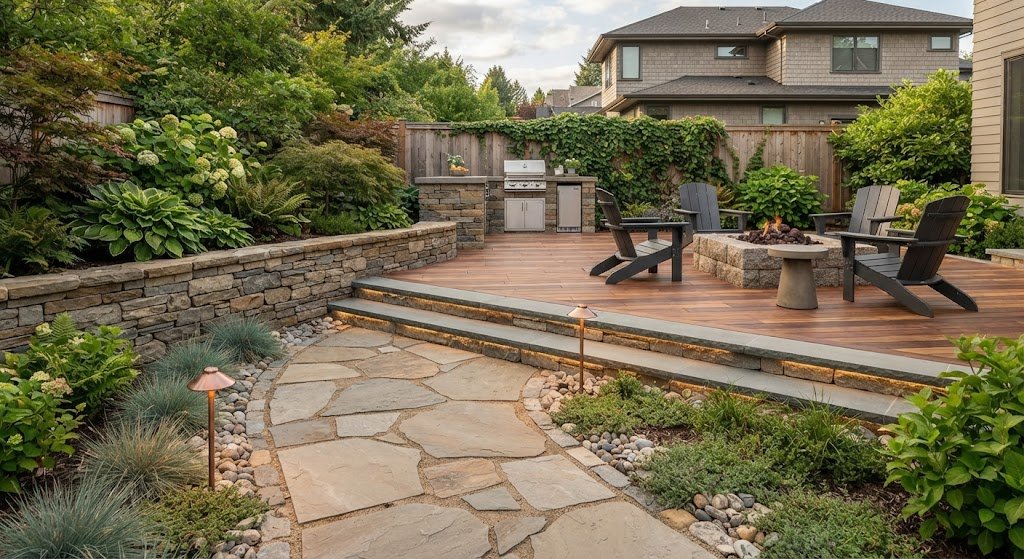
Hardscaping is the part of an outdoor space built from durable materials rather than living plants. Patios, pathways, driveways, retaining walls, steps, fire-pit areas, edging, and stone features all fall under this category.
Good hardscaping does more than make a garden look finished. It can create useful outdoor rooms, improve movement around a property, manage changes in ground level, define planting areas, and make an awkward yard easier to use. The challenge is choosing materials and layouts that suit the house, climate, drainage, maintenance needs, and budget.
This guide explains the main types of hardscape features, the materials commonly used for them, how to plan a project, where costs can rise, and the mistakes worth avoiding.
What Is Hardscaping?
Hardscaping refers to the non-living, constructed elements of a landscape. It is often planned alongside soft landscaping, which includes grass, trees, shrubs, flowers, and other plants.
Common examples include:
- Patios and terraces
- Walkways and garden paths
- Driveways
- Steps and ramps
- Retaining walls
- Garden walls
- Stone or brick edging
- Outdoor seating areas
- Fire-pit spaces
- Water-feature structures
- Gravel areas
- Fences and certain built landscape structures
The two sides of a landscape work together. A paved patio may provide the usable surface, while surrounding planting softens its appearance. A retaining wall may hold back soil while also creating a planting bed.
The best design usually treats these elements as one connected outdoor space rather than a collection of separate projects.
Why Hardscaping Matters in Outdoor Design
A well-planned outdoor area needs more than attractive materials. It needs a layout that works.
Hardscape features can help you:
Create usable outdoor rooms
A patio can become an outdoor dining area, lounge, cooking space, or gathering spot. The surface gives furniture a stable base and establishes a clear boundary for the space.
Improve movement
Paths guide people between the house, garage, garden, entrance, shed, and other destinations. Their position matters just as much as their appearance.
Deal with changes in elevation
Sloping gardens can be difficult to use. Steps, terraces, walls, and carefully designed transitions can divide a steep area into more practical levels.
Define planting areas
Edging and low walls can separate lawns, planting beds, gravel, and paved surfaces. This creates clearer lines and can make routine maintenance easier.
Make an outdoor space feel intentional
A carefully chosen paving pattern, wall material, or border can connect an outdoor area visually with the architecture of the home.
Popular Hardscaping Ideas
There is no single formula for an attractive outdoor space. The right combination depends on how you use the property.
1. Build a Practical Patio
A patio is one of the most useful additions to a garden or backyard.
Before choosing the surface, consider what will actually happen there. A small table and two chairs require much less room than a dining table, outdoor sofa, grill, and walking space.
Think about:
- Furniture size
- Door locations
- Sun and shade
- Views from the house
- Drainage
- Access for construction
- How people will move through the space
A patio that looks large on a plan can feel cramped once furniture is added.
2. Add a Defined Garden Path
A path does not always need to run in a perfectly straight line. Its shape should make sense for the destinations it connects.
Use paths to link areas such as:
- Front entrance to driveway
- House to garden
- Patio to lawn
- Kitchen door to outdoor cooking area
- Garden to shed or utility space
For frequently used routes, prioritize a stable, comfortable surface. Decorative paths used less often can allow more flexibility in material and shape.
3. Create a Gravel Courtyard
Gravel can be a practical option for courtyards, seating areas, paths, and informal garden spaces.
It can also be easier to shape around existing planting than rigid paving. However, loose aggregate can move underfoot and may not be ideal for every application.
A properly prepared base, suitable edging, and an appropriate aggregate size can make a major difference.
4. Use Retaining Walls on Sloped Ground
Retaining walls hold soil where there is a change in elevation. They can also create terraces and separate different parts of a garden.
However, a retaining wall is more than a decorative feature. Its design needs to account for soil pressure, drainage, foundation conditions, wall height, materials, and local requirements.
For substantial walls or difficult sites, professional structural or landscape advice is sensible.
5. Frame Planting Beds With Edging
Simple edging can give a garden a cleaner appearance without covering a large area in hard materials.
Possible edging materials include:
- Brick
- Stone
- Concrete
- Metal
- Timber where appropriate
- Manufactured landscape edging
Choose an edging system that suits the surrounding materials and expected maintenance. The goal is to create a useful boundary rather than simply add another decorative element.
6. Design an Outdoor Dining Area
If outdoor meals are a priority, design the hardscape around the furniture rather than choosing the paving first.
Leave enough space for chairs to move away from the table. Consider the location of the kitchen or indoor dining area, too. A beautiful outdoor dining space becomes less convenient if every meal requires carrying food across the entire garden.
7. Add a Fire-Pit Area Carefully
A fire-pit area can create a natural focal point, but fire safety needs to come before aesthetics.
Use a suitable non-combustible surface and maintain appropriate separation from structures, vegetation, fences, and other combustible materials. Local fire restrictions and regulations may also apply.
Never assume that a decorative stone surface automatically makes a fire-pit installation safe.
Hardscape Materials: Which One Should You Choose?
Material selection affects appearance, durability, maintenance, installation, drainage, and cost.
| Material | Strengths | Things to Consider |
|---|---|---|
| Natural stone | Distinctive appearance and natural variation | Quality and installation costs can vary |
| Concrete pavers | Many shapes, colours, and patterns | Joints can collect weeds or debris |
| Poured concrete | Flexible shapes and generally simple appearance | Cracking and surface changes need consideration |
| Brick | Traditional appearance and useful for borders or paving | Individual units can shift if the base is poor |
| Gravel | Flexible and often suitable for informal areas | Can move and may require periodic replenishment |
| Porcelain paving | Clean appearance and low water absorption | Requires suitable installation and careful handling |
| Wood decking | Warm appearance and comfortable underfoot | Requires appropriate material and maintenance |
| Composite decking | Consistent appearance and generally lower routine maintenance than many timber options | Appearance and heat retention vary by product |
No material is automatically right for every property. The best choice depends on the job.
For example, the requirements for a driveway are different from those for a garden path. Vehicle loads, drainage, freeze-thaw exposure, slip resistance, installation method, and local climate all matter.
Natural Stone vs. Manufactured Pavers
Natural stone and manufactured paving products can both work well, but they create different visual effects.
Natural stone typically has variation in colour, texture, thickness, and pattern. That variation can give a garden a less uniform appearance.
Manufactured pavers offer greater consistency. They are often available in coordinated shapes, colours, and sizes, making it easier to create repeated patterns.
When comparing the two, look beyond the price of the individual material. Installation requirements, preparation, cutting, waste, delivery, edging, drainage, and labour can all affect the final project cost.
How to Plan a Hardscaping Project
A little planning can prevent expensive changes later.
Step 1: Decide how the space will be used
Start with activities, not materials.
Ask:
- Do I need dining space?
- Where will people sit?
- Does the garden need a clear walking route?
- Will children or pets use the area?
- Do vehicles need access?
- Is storage part of the plan?
- Do I need to solve a drainage or slope problem?
These answers determine the layout.
Step 2: Study the existing site
Look at the garden after rain as well as on a dry day.
Pay attention to:
- Water collecting in low spots
- Slopes
- Existing drains
- Downspouts
- Tree roots
- Soil conditions
- Boundaries
- Utility services
- Access for materials and equipment
A visually attractive design can become a headache if it sends water toward the house or blocks existing drainage.
Step 3: Plan drainage before surfaces
Drainage deserves attention before paving, walls, or other permanent structures are installed.
Hard surfaces reduce the amount of ground available for water to infiltrate. The exact drainage approach depends on the surface, site, soil, slope, climate, and local rules.
In some situations, permeable paving or gravel can help manage runoff, but the material alone does not guarantee effective drainage. The complete build-up beneath the surface matters.
Step 4: Choose materials that suit the property
Look at the house exterior, roof, windows, fences, and existing garden materials.
A useful rule is to coordinate rather than match everything exactly.
For instance, a contemporary home may work well with clean-lined paving and restrained planting, while a traditional property might suit brick, natural stone, or more informal patterns.
Step 5: Consider maintenance
Ask what the surface will look like after several seasons, not just on installation day.
Consider:
- Cleaning
- Weed growth
- Moss or algae
- Joint maintenance
- Staining
- Surface sealing
- Replacement of damaged units
- Movement caused by frost or ground conditions
A material that looks perfect but demands more maintenance than you want may not be the right choice.
What Affects Hardscaping Costs?
There is no reliable single price for a hardscaping project because the scope can range from a small gravel path to extensive patios, walls, steps, and drainage work.
Major cost factors include:
- Size of the project
- Material selected
- Ground preparation
- Excavation
- Soil conditions
- Slope
- Drainage requirements
- Retaining walls
- Steps or changes in level
- Site access
- Waste removal
- Labour
- Delivery
- Design or engineering services
- Local labour and material prices
The cheapest material is not necessarily the cheapest finished project.
For example, difficult excavation or poor site access can have a greater effect on the final bill than the difference between two surface materials.
For a larger project, get itemized estimates rather than comparing only the headline total.
Hardscaping for Small Gardens
Small outdoor spaces benefit from restraint.
Instead of trying to include every possible feature, decide what deserves the most space.
A compact garden might combine:
- A modest seating patio
- One clear pathway
- A narrow planting border
- Vertical planting
- Simple edging
- A small focal feature
Using too many materials can make a small space feel visually fragmented.
A consistent paving material can make the area appear more connected, while planting can provide contrast and softness.
Hardscaping for Large Gardens
Large properties offer more flexibility, but they also create a risk: disconnected zones.
Instead of spreading isolated features across the garden, create a hierarchy.
For example:
House → main terrace → pathway → lawn → secondary seating area
This gives the landscape a sense of movement and purpose.
Changes in paving, planting, wall height, or level can distinguish different zones without making every area feel like a separate room.
Climate Matters More Than Many Homeowners Expect
A material that performs well in one location may require a different installation approach elsewhere.
In colder climates
Freeze-thaw cycles can contribute to movement or damage when water enters materials or poorly drained construction layers and freezes. Proper base preparation and drainage are especially important.
In hot climates
Dark surfaces can become very hot in direct sunlight. Material colour, shade, surface texture, and intended use should all be considered.
In wet climates
Persistent moisture can encourage moss or algae on some surfaces, particularly where sunlight and airflow are limited.
In dry climates
Water conservation may influence the balance between paved areas, planting, and permeable surfaces.
The important point is that hardscape design should respond to local conditions rather than copying a design from a different climate.
Common Hardscaping Mistakes to Avoid
Choosing materials before planning the layout
A beautiful paving sample cannot fix a poorly designed garden.
Start with circulation, activities, drainage, and dimensions.
Ignoring the finished ground level
New paving changes the elevation of the surface. If levels are poorly planned, water may collect against buildings, steps may become awkward, or transitions may become trip hazards.
Underestimating the importance of the base
Many hardscape failures are related to inadequate preparation rather than the visible surface itself.
The appropriate foundation depends on the material, soil, loading, climate, and site conditions.
Making every area the same
Uniformity can be useful, but a garden does not need the same surface everywhere.
Use materials deliberately to distinguish major areas.
Forgetting access
Think about how materials will reach the site before construction begins.
A backyard with no vehicle access may require more manual handling, which can affect both scheduling and cost.
Adding drainage as an afterthought
Water should be considered during the initial design. Retrofitting drainage after paving and walls are complete can be disruptive and expensive.
Making paths too narrow
A pathway needs to accommodate its actual use. Consider whether people will pass each other, carry items, push a stroller, move garden equipment, or walk beside a pet.
Overbuilding the garden
More paving does not automatically make an outdoor space better.
Leave enough room for plants, shade, wildlife, and the activities that make the garden enjoyable.
Hardscaping and Soft Landscaping Work Better Together
A successful landscape usually balances built surfaces with living elements.
Hard surfaces provide structure. Plants provide colour, seasonal change, texture, shade, and softness.
For example, a large paved patio can feel harsh when surrounded entirely by hard boundaries. Planting beds, trees, pots, groundcover, or other suitable vegetation can visually soften the edges.
The reverse is also true. Too much planting without clear paths or usable surfaces can make a garden difficult to navigate.
The strongest designs give both parts a job.
When Should You Hire a Professional?
Simple projects such as small decorative gravel areas or straightforward garden edging may be manageable for an experienced DIY homeowner.
Professional help becomes more valuable when a project involves:
- Significant excavation
- Major changes in elevation
- Retaining walls
- Complex drainage
- Large paved areas
- Driveways
- Structural elements
- Difficult access
- Utility services
- Building-adjacent work
- Local planning or building requirements
Requirements differ between locations, so check applicable local rules before construction. In the UK and US, drainage, planning, building, property-boundary, accessibility, and other requirements can vary by jurisdiction and project type.
For structural walls or other elements where failure could cause significant damage or injury, appropriate professional design is particularly important.
A Simple Hardscape Planning Checklist
Before ordering materials, check the following:
- The main purpose of the space is clear.
- Furniture dimensions have been considered.
- Walking routes make sense.
- Existing drainage has been assessed.
- Finished ground levels have been planned.
- The material suits the local climate.
- The surface is appropriate for its expected load.
- Maintenance requirements are acceptable.
- Construction access has been considered.
- Existing trees and roots have been assessed.
- Local requirements have been checked.
- The budget includes preparation and installation, not just materials.
- Drainage has been considered before construction starts.
Frequently Asked Questions
What is the difference between hardscaping and landscaping?
Hardscaping generally refers to constructed, non-living landscape elements such as patios, paving, paths, walls, steps, and driveways. Landscaping is a broader term that can include both hardscape features and living elements such as lawns, trees, shrubs, and flowers.
Is hardscaping expensive?
It can range from relatively simple projects to major construction work. The final cost depends on materials, project size, excavation, ground conditions, drainage, access, labour, and structural requirements. A small gravel path and a large paved terrace should not be expected to have similar costs.
What is the most durable hardscape material?
There is no single material that is the most durable for every application. Durability depends on the material, installation, expected loads, climate, drainage, and maintenance. A surface suitable for a pedestrian path may not be suitable for a driveway.
Does hardscaping require maintenance?
Yes. Maintenance varies by material and design. Paved surfaces may need cleaning and joint maintenance, gravel may need raking or replenishment, and some materials may benefit from periodic sealing depending on the product and application.
Can hardscaping help with drainage?
It can, but the design must be considered as a complete system. Grading, surface type, joints, underlying layers, drains, soil conditions, and discharge points can all affect how water behaves. Simply installing a particular paving material does not automatically solve drainage problems.
Is hardscaping suitable for a small garden?
Yes. Small gardens can benefit from carefully planned patios, paths, edging, gravel areas, and level changes. The key is to prioritize the activities you actually want to support instead of filling the available space with too many features.
Conclusion
Hardscaping gives an outdoor space its physical structure, but good design starts with how the space needs to work. Before choosing paving, stone, brick, gravel, or another material, think about movement, drainage, ground levels, climate, maintenance, access, and the relationship between the house and garden.
For a small project, simplicity is often enough. For a larger project involving slopes, drainage, retaining walls, driveways, or structural features, careful planning and professional advice can prevent costly problems later.
The strongest outdoor spaces are not necessarily the ones with the most features. They are the ones where every surface, path, wall, and planting area has a clear purpose.



















