

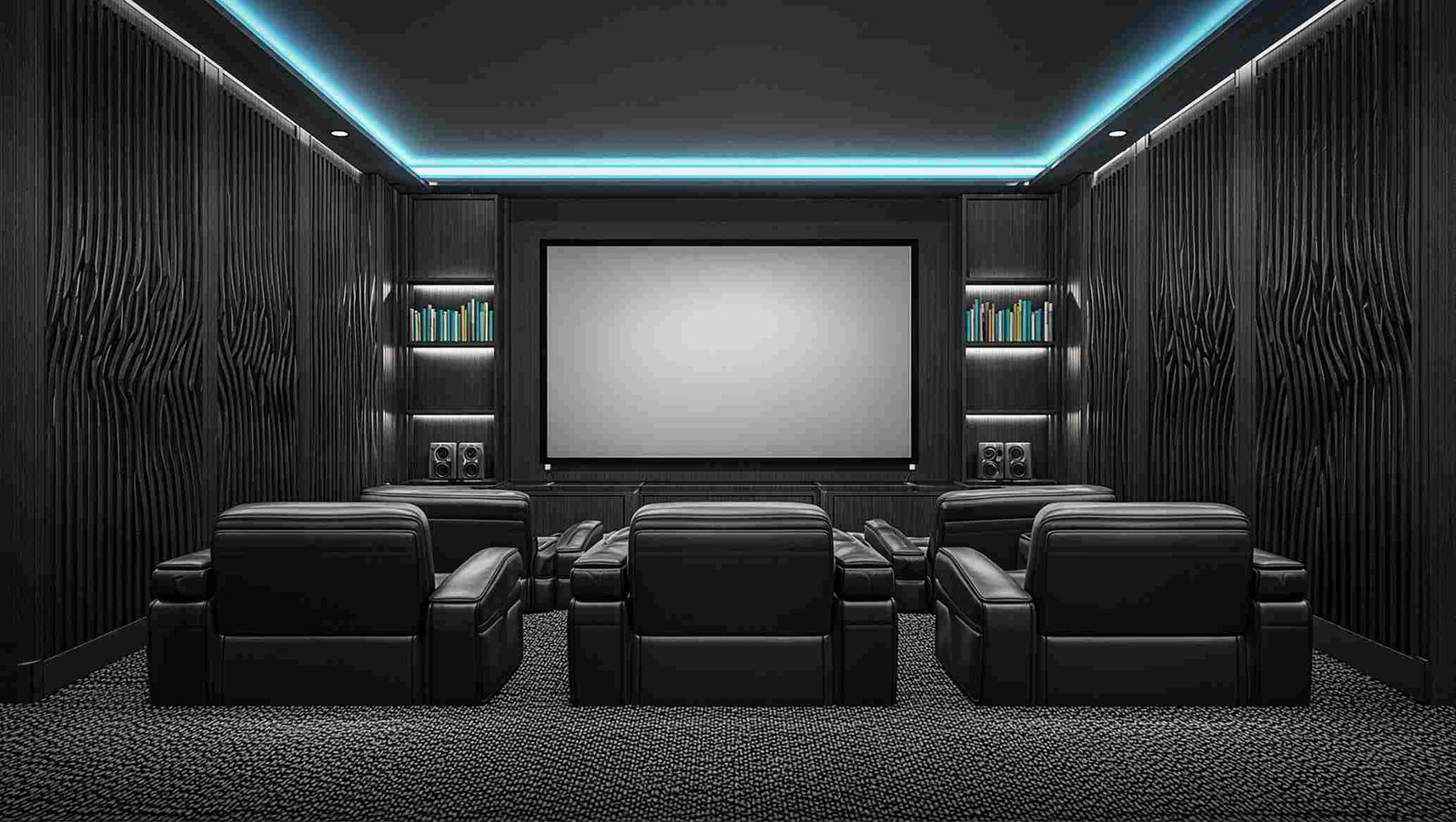
A great home theater should feel like a cinema without making your house feel like a commercial theater. The best home theater design ideas 2026 combine picture quality, immersive sound, comfortable seating, controlled lighting, and attractive interior design.
The biggest design lesson is simple: plan the room before buying the equipment. Screen size, seating position, speaker locations, wall treatments, lighting, ventilation, and cable routes all affect the final experience. Professional home cinema design guidance also treats audio, video, room layout, lighting, heat, and data as parts of the same design rather than separate jobs.
Whether you have a dedicated basement cinema or a small living-room media space, you can create a room that looks polished and performs well.
1. Create a Dark, Cozy Cinema Room
One of the easiest ways to make a room feel cinematic is to control its visual environment.
Deep charcoal, warm brown, navy, muted green, and other low-reflectance finishes can create a relaxed atmosphere while reducing distracting reflections from the screen.
You do not have to make every surface black. Instead, consider:
- Dark painted walls
- A darker ceiling around the screen
- Heavy curtains
- Soft carpet
- Upholstered furniture
- Matte finishes instead of glossy surfaces
- Darker acoustic panels
- Subtle decorative lighting
The goal is not simply to make the room dark. It is to make the screen the visual focus.
For a family media room, you can soften the look with wood accents, framed artwork, textured fabrics, or warm neutral colours.
2. Try a Modern Black-and-Wood Home Theater
Black and wood make a particularly effective combination for a modern cinema.
Use dark walls or acoustic panels as the backdrop, then introduce walnut, oak, or another warm wood tone through:
- Wall panels
- Cabinetry
- Door finishes
- Floating shelves
- Speaker enclosures
- Side tables
- Ceiling details
The wood keeps the room from feeling cold, while darker surfaces help maintain the cinema atmosphere.
This approach works especially well when you want the room to feel like part of the home’s interior rather than a completely separate entertainment box.
3. Design Around the Seating Position First
A common mistake is to decide where the screen will go and then squeeze the seating into whatever space remains.
Reverse that process.
First decide where the primary seats will be. Then work outward to determine the screen, speakers, projector, lighting, and other equipment.
Your main seating position affects almost everything else in the room.
Consider:
- Distance from the screen
- Viewing angle
- Speaker angles
- Sight lines
- Door locations
- Walkways
- Recliner clearance
- Additional seating
- Access to equipment
THX currently provides different room-size categories ranging from compact rooms with roughly 8-foot viewing distances to much larger cinema spaces with viewing distances around 12 or 20 feet. These are useful reference points, but your exact screen and seating relationship should be designed for the room rather than copied blindly.
4. Use Tiered Seating for a True Cinema Feel
If your room has enough depth and ceiling height, tiered seating can dramatically improve the experience.
A raised second row helps viewers see over the people sitting in front. It can also give the room a stronger theater identity.
Popular layouts include:
Two Rows of Recliners
This is ideal for dedicated movie rooms. The front row provides the primary viewing position while the raised rear row accommodates additional guests.
Sofa + Rear Recliners
For a more relaxed family room, use a large sofa in front with individual recliners behind it.
Single Row
A single row can actually be the better choice in a smaller room. You avoid crowding the space and can focus your budget on better seats, sound, and picture quality.
Do not add a second row simply because it looks impressive. Every seat should have a comfortable view and enough room to move around.
5. Build a Dedicated Dolby Atmos-Style Sound System
Immersive audio is one of the most important parts of a modern home theater.
Traditional surround sound places speakers around the listener. Immersive systems add an upper layer of speakers to create a sense of sound coming from above as well as around the room. CEDIA’s RP22 describes immersive audio using listener-level and upper speaker layers, including height or overhead speakers.
For a dedicated theater, you might consider configurations such as:
- 5.1
- 7.1
- 5.1.4
- 7.1.4
- Larger systems for bigger rooms
The first number generally represents main surround speakers, the second represents subwoofer channels, and the third represents upper-layer speakers.
Dolby’s professional guidance published in July 2026 identifies 7.1.4 as its preferred minimum configuration for an Atmos home entertainment mix room, while noting that 5.1.4 can also be used. A residential playback room does not necessarily need to follow studio requirements, but the guidance illustrates why speaker planning matters.
Why Speaker Placement Matters
Buying expensive speakers does not compensate for poor placement.
CEDIA’s immersive-audio recommendations emphasize defined speaker layouts and engineering-based performance targets rather than simply choosing equipment by price.
Plan speaker positions before installing walls or ceilings.
6. Add Two Subwoofers When the Room Allows
Bass behaves differently from midrange and high-frequency sound because low-frequency waves interact strongly with the room.
That is why adding a second subwoofer can be more useful than simply buying a larger single subwoofer.
Multiple subwoofers can help produce more consistent bass across different seats when properly positioned and calibrated.
THX also emphasizes the importance of subwoofers in home theater systems because they reproduce the low-frequency effects that give movie soundtracks physical impact.
The important word is properly. Two subwoofers placed randomly are not automatically better than one well-integrated subwoofer.
7. Treat the Room for Better Acoustics
Beautiful theater rooms can still sound disappointing if the room has excessive reflections.
Hard walls, glass, bare floors, and large reflective surfaces can make dialogue less clear and sound effects less controlled.
Acoustic treatment can include:
- Wall absorption panels
- Bass traps
- Carpet
- Heavy curtains
- Upholstered furniture
- Diffusion elements
- Acoustic ceiling treatments
The goal is not to make the room completely dead. Good acoustic design balances absorption and reflection so the soundtrack remains clear and natural.
CEDIA’s professional home cinema training specifically includes acoustic and audio considerations as part of the design process, while its homeowner guidance recommends considering room size, layout, technology, and how the room will be used before planning a theater.
8. Hide Acoustic Panels Inside the Decor
Acoustic treatment does not have to look like studio equipment.
Modern designs can disguise acoustic treatment as part of the interior.
For example, fabric-covered panels can match the walls, while decorative wood slats can provide a visually attractive architectural feature.
Another option is to place acoustic material behind acoustically transparent fabric or decorative surfaces.
This creates a room that looks sophisticated when the lights are on but still performs well when the movie begins.
9. Choose Between a Projector and a Large TV
There is no universal winner.
The right display depends on room size, lighting, viewing distance, budget, and how you use the room.
| Display option | Best for | Main advantage | Main limitation |
|---|---|---|---|
| Large OLED TV | Small to medium rooms | Excellent contrast and simple installation | Screen size is limited compared with projection |
| Large LED/LCD TV | Bright multipurpose rooms | High brightness and easy everyday use | Can look more like a living room than a cinema |
| Projector + screen | Dedicated theaters | Very large cinematic image | Requires more planning and light control |
| Ultra-short-throw projector | Flexible rooms | Large image from a short distance | Screen and room setup still matter |
A projector makes particular sense when the room is dedicated to movies and can be darkened effectively.
A large television may be more practical if the space is also used for daytime viewing, gaming, sports, and general family entertainment.
10. Use a Large Screen Without Going Too Far
Bigger is not automatically better.
The screen should be large enough to feel immersive while still allowing comfortable viewing from the seating position.
THX recommends designing dedicated cinema spaces around appropriate viewing geometry and cites a 36-degree horizontal viewing angle from the farthest seat as a reference for its certified screen-placement approach. It also emphasizes unobstructed sight lines.
That means screen size should be selected together with seating distance.
Instead of asking, “What is the biggest screen I can buy?” ask:
“What screen size feels comfortable from my main seat?”
That small change in thinking can prevent an oversized display from dominating the room.
11. Create a Starry Ceiling
A fiber-optic star ceiling can turn an ordinary theater into a dramatic feature room.
Tiny points of light across a dark ceiling create the appearance of a night sky. You can use:
- Small fiber-optic points
- Random star patterns
- Constellation-inspired layouts
- A subtle border
- A larger concentration of stars toward the center
Keep the effect dim. If the ceiling lights are bright enough to compete with the screen, the feature becomes distracting.
A recent CEDIA project example also demonstrates how a custom fiber-optic star ceiling can be incorporated into a dedicated home cinema design.
12. Use Layered Lighting Instead of One Ceiling Light
Lighting has a major impact on how a theater feels before, during, and after a movie.
Instead of one bright overhead fixture, create several lighting zones.
Useful lighting zones include:
- Step lights
- Wall sconces
- Recessed lights
- Ceiling perimeter lighting
- LED strips
- Backlighting
- Cabinet lighting
- Entry lighting
The most useful feature is independent control.
You might have one scene for Movie, another for Pause, and another for Cleaning.
During the movie, low-level pathway lighting can help people move safely without flooding the screen with light.
13. Add Smart Lighting Scenes
Smart home control can make a theater easier to use.
A single command could lower the lights, close blackout curtains, switch on the projector, select the correct source, and start the audio system.
The important point is not to add automation simply because it is available.
Automate the tasks you perform repeatedly.
Useful scenes might include:
Movie: lights dim, curtains close, display starts, audio switches to the theater source.
Game: brighter pathway lighting, display switches to the console, and audio changes to the preferred gaming mode.
Pause: low room lighting comes back on without fully illuminating the screen.
End: equipment shuts down and normal room lighting returns.
14. Make a Small Home Theater Feel Bigger
You do not need a huge basement for a good media room.
For a compact room:
- Use one seating row.
- Choose a display appropriate for the viewing distance.
- Use wall-mounted or in-wall equipment where practical.
- Avoid oversized furniture.
- Keep walkways clear.
- Use darker finishes around the screen.
- Consider a sound system designed for the room.
- Use acoustic treatment strategically.
- Keep equipment accessible for maintenance.
THX’s current room-size guidance specifically includes compact systems for rooms of up to about 1,000 cubic feet with an approximately 8-foot viewing distance, showing that smaller rooms can still be designed as dedicated entertainment spaces.
15. Design a Multipurpose Media Room
Not everyone needs a dedicated cinema.
A multipurpose media room can combine:
- Television viewing
- Movies
- Gaming
- Sports
- Music
- Family gatherings
- Casual entertaining
Use attractive furniture instead of fixed theater seating, and choose finishes that work with the rest of the house.
A large TV, sound system, blackout curtains, comfortable sectional, dimmable lighting, and discreet acoustic treatment can create an excellent everyday entertainment room.
This is often the smarter approach when the room needs to serve several purposes.
16. Build a Home Theater Around Gaming
A modern theater does not have to be movie-only.
If gaming is important, plan for it from the beginning.
Consider:
- Low-latency display options
- Comfortable seating
- Accessible console connections
- Extra HDMI connectivity
- Good ventilation
- Flexible lighting
- Cable management
- Network connectivity
- Surround or immersive audio
A large screen can make racing, sports, adventure, and multiplayer games especially engaging.
Just make sure the seating arrangement works for gaming as well as movies.
17. Create a Hidden Equipment Rack
A clean room usually looks better without receivers, game consoles, streaming boxes, and cables scattered around the seating area.
Consider placing equipment in:
- A ventilated cabinet
- A dedicated closet
- A nearby utility space
- A purpose-built equipment rack
Do not seal electronics into an unventilated cabinet. AV equipment produces heat, so airflow and service access need to be considered during planning.
CEDIA’s professional cinema-design guidance specifically treats factors such as data, heat, lighting, audio, and video as part of the overall design process.
18. Plan Cable Routes Before Construction
This is one of the least exciting parts of theater design—and one of the most important.
Before closing walls or ceilings, plan routes for:
- Speaker cables
- HDMI connections
- Network cables
- Projector connections
- Subwoofer cables
- Power
- Control wiring
Leave appropriate pathways for future upgrades where practical.
Technology changes. A room that is easy to upgrade later can save considerable disruption.
CEDIA also lists HDMI system design and verification among its published standards and recommended practices, reinforcing that signal distribution deserves proper planning rather than being treated as an afterthought.
19. Add a Snack Bar or Mini Concession Area
A small concession area can make a home theater more entertaining without turning it into a full commercial-style cinema.
You could add:
- A compact counter
- Popcorn machine
- Mini fridge
- Cup holders
- Storage drawers
- Beverage shelves
- Snack cabinets
For smaller rooms, a simple built-in cabinet may be enough.
If you have a larger basement, a separate bar can become a major design feature.
20. Use Carpet for Comfort and Sound Control
Carpet is popular in dedicated home theaters for good reason.
It adds comfort underfoot and can help reduce reflections from a hard floor.
A dark carpet also supports the traditional cinema look.
However, you do not have to cover the entire room in black carpet. Charcoal, deep brown, navy, or another dark neutral can work well with the rest of the interior.
For a multipurpose room, a large area rug can provide some of the same visual warmth while maintaining a more residential appearance.
21. Add a Statement Wall Behind the Screen
The screen wall deserves special attention because it is usually the room’s visual focal point.
Good approaches include:
- Dark acoustic fabric
- Wood slats
- Minimal paneling
- Built-in cabinetry
- Hidden speakers
- Backlighting around the screen
- Simple architectural molding
Avoid excessive decoration immediately around the display. Too many visual elements can compete with the image.
22. Try a Luxury Home Cinema Look
For a more upscale room, combine restrained materials rather than filling every surface with decoration.
A luxury design might use:
- Deep-colored walls
- Velvet or leather seating
- Walnut or oak details
- Integrated lighting
- Acoustic wall panels
- Hidden speakers
- A large projection screen
- Custom cabinetry
- Soft carpet
- Automated curtains
The key is coordination.
Expensive equipment will not make a room look luxurious if the furniture, lighting, finishes, and cable management feel disconnected.
23. Add Family-Friendly Storage
If children use the room, storage becomes surprisingly important.
Add cabinets for:
- Controllers
- Board games
- Blankets
- Headphones
- Streaming accessories
- Charging equipment
- DVDs or Blu-rays
- Gaming consoles
Closed storage keeps the room looking clean between movie nights.
24. Don’t Forget Ventilation and Temperature
A home theater can contain several heat-producing devices in one enclosed space.
AV receivers, amplifiers, projectors, gaming equipment, networking hardware, and other electronics can all contribute to heat.
Plan ventilation before installation.
A dedicated equipment closet may require its own airflow strategy. The room itself also needs comfortable temperature control, particularly during long movie sessions.
A quiet HVAC solution is preferable because noisy air movement can become noticeable during quiet scenes.
25. Avoid These Common Home Theater Design Mistakes
A beautiful theater can still perform poorly when basic planning is overlooked.
Buying equipment before planning the room
Start with the room, seating, screen, and speaker layout. Then select equipment that fits those requirements.
Making the screen too large
An oversized image can become uncomfortable when viewed from too close.
Ignoring acoustics
A powerful sound system cannot completely overcome a poorly controlled room.
Putting all speakers wherever they fit
Speaker location affects the spatial experience. Plan positions before construction.
Using bright lighting
Bright lights and reflective finishes can distract from the screen.
Blocking sight lines
Check every seat, not just the center seat.
Forgetting equipment ventilation
Enclosed electronics need appropriate airflow.
Running too few cables
Plan for future devices rather than assuming today’s connections will be enough.
Overdecorating
A theater should feel immersive, not visually chaotic.
26. A Practical Home Theater Planning Checklist
Before purchasing equipment, work through this checklist:
Room
- What is the room’s length, width, and ceiling height?
- Is it dedicated or multipurpose?
- Where are doors and windows?
- Can outside light be controlled?
Seating
- Where is the primary viewing position?
- How many people need to sit comfortably?
- Is tiered seating practical?
- Are sight lines clear?
Video
- TV or projector?
- What screen size suits the viewing distance?
- Where will the display be mounted?
- Is the projector location practical?
Audio
- 5.1, 7.1, or an immersive configuration?
- Where will the speakers go?
- Is there room for one or more subwoofers?
- Does the room need acoustic treatment?
Lighting
- Can the room be fully darkened?
- Are lights independently controlled?
- Is pathway lighting needed?
Technology
- Where will the receiver and other equipment live?
- Is ventilation adequate?
- Are network connections available?
- Have future cable routes been considered?
Interior
- What wall colours work with the screen?
- What flooring is appropriate?
- Do acoustic treatments fit the design?
- Does the furniture match the rest of the home?
27. How to Choose the Right Home Theater Style
The best design depends on how you actually use the room.
| Your priority | Design direction |
|---|---|
| Serious movie watching | Dedicated dark cinema with immersive audio |
| Family entertainment | Comfortable multipurpose media room |
| Gaming | Large display, flexible seating, accessible connections |
| Luxury appearance | Custom finishes, integrated lighting, concealed equipment |
| Small space | Single seating row, compact audio, carefully sized display |
| Large basement | Tiered seating, projection, multiple subwoofers, dedicated equipment area |
| Minimalist home | Hidden speakers, simple cabinetry, restrained finishes |
| Traditional cinema | Dark walls, theater seats, carpet, sconces and classic details |
There is no single correct home theater layout. The best design is the one that fits the room and the people who will use it.
FAQ
What are the best home theater design ideas for 2026?
The strongest design directions for 2026 focus on immersive audio, carefully planned seating, controlled lighting, acoustic treatment, concealed equipment, large displays or projection, and smart room control. Current professional guidance increasingly emphasizes measurable system performance and coordinated room design rather than choosing equipment in isolation.
Is a projector better than a large TV for a home theater?
A projector is often attractive for a dedicated cinema because it can provide a very large image. A large TV may be better for a multipurpose room, particularly when the room receives daylight or is used for gaming and everyday viewing.
Does a small room work for a home theater?
Yes. A small room can work very well with one seating row, an appropriately sized display, compact speakers, good acoustic treatment, and controlled lighting. The key is matching the system to the room instead of trying to recreate a large commercial cinema in a space that cannot support it.
How many speakers should a home theater have?
It depends on the room and desired level of immersion. Common configurations include 5.1 and 7.1, while systems with overhead speakers can use configurations such as 5.1.4 or 7.1.4. Speaker layout should be planned around the seating positions and room geometry.
Are acoustic panels necessary in a home theater?
Not every room needs the same amount of treatment, but acoustics should be considered in any serious theater design. Hard, reflective surfaces can affect clarity and reverberation, while properly selected absorption and diffusion can help control the room’s sound.
Should home theater equipment be hidden?
It can be. A ventilated equipment cabinet or separate rack can keep the room cleaner while making the system easier to control. Just make sure equipment remains adequately ventilated and accessible for maintenance.
Conclusion
The best home theater design ideas 2026 are not really about buying the most expensive screen or the largest number of speakers. They start with the room.
Plan the seating first, establish comfortable viewing geometry, position the speakers around the listeners, control reflections and light, provide ventilation, and hide cables wherever practical. Then choose technology that supports the design.
For a dedicated cinema, that might mean tiered recliners, projection, immersive audio, acoustic treatments, and smart lighting. For a family media room, a large TV, comfortable sofa, good sound, blackout curtains, and flexible lighting may be the smarter solution.
A successful home theater should look good when the lights are on, disappear into the background when the movie starts, and give every person in the room a comfortable reason to stay for one more film.



















